
By De Birhan
14 March 2013




The full Report can be read HERE.
14 March 2013
A new report titled "Agricultural Growth Program (AGP) of Ethiopia—Baseline Report 2011" by the International Food Policy Research Institute – Ethiopia Strategy Support Program II, Ethiopia released today March 14, 2013 has revealed the existence of huge disparities in development among four major Regional States of Ethiopia. Tigary Region has fared better in most variables compared to other Regions.
According to the Report, the Agricultural Growth Program (AGP) is a component of this broad effort that will commence in 2011 and is a five-year program. The AGP has two main components: Agricultural Production and Commercialization and the Small-scale Rural Infrastructure Development and Management.
Some of these tables show the disparities clearly,


Similarly as can been seen below, in accessibility of the first most important road, by region - a larger proportion of roads are accessible during rainy seasons to any vehicle in AGP EAs of Tigray, although the proportion accessible on foot is a close second. This is despite the proportion of dirt roads in AGP EAs of Tigray is the largest relative to an average, AGP, and non-AGP EAs of all other regions (excepting non-AGP EAs of the same region and that of SNNP).

In terms of sources of Drinking Water, regionally, a significantly larger proportion of EAs in Tigray and a slightly larger proportion in Amhara have access to piped water, relative to an average EA in the overall sample.At 45 percent the largest proportion of EAs in Tigray get their drinking water from pipes during dry seasons, making Tigray best performing in tap water.The proportion of EAs that use wells, piped water, and lakes and other sources as their most important source of drinking water is third to fifth largest in Amhara.

The table below shows About 19 percent of the 304 EAs have access to electricity services with better access to electricity in AGP EAs. All 3 categories of EAs in Tigray and average and AGP EAs in Amhara have better access to electricity, relative to their national counterparts. Access to electricity is poorer in non-AGP EAs in Amhara, and in all 3 categories of EAs in Oromiya. In a large proportion of the EAs in Tigray, i.e. 39 percent, electricity services are excellent or good followed by poor or erratic services, at 33 percent.
In Amhara, electricity services are fair for the largest proportion followed by poor or erratic services, which is about the same in Oromiya. Out of the 304 EAs, 222 or 73 percent have cell phone coverage.For an average EA in Tigray the proportion receiving fair and excellent or good signals is largest and second largest.

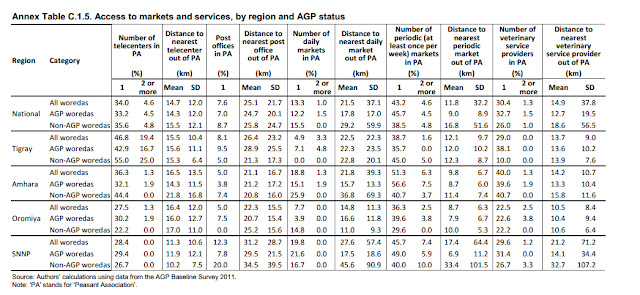
The next table reveals that of the studied areas, relative to an average, AGP, and non-AGP EAs nationally, a larger proportion in Tigray have at least one telephone center while a lower proportion in Oromiya and SNNP have such services. The only region with all 3 subgroups performing better in access to post offices is SNNP; particularly, non-AGP EAs of SNNP have a rather large proportion of 20 percent. All 3 categories of Amhara and Oromiya perform worse relative to their national counterparts. While average and AGP EAs in Tigray perform better than their national counterpart, non-AGP EAs in Tigray perform worse.

With regards to relative to the corresponding national average, the
proportion of EAs with at least one government clinic is larger in all 3 categories of Tigray and SNNP; particularly, non-AGP EAs in Tigray have a markedly higher clinic availability of 95 percent. A lower proportion of EAs in all 3 categories of Oromiya and average and nonAGP EAs in Amhara have clinics. There are 33 pharmacies providing services in 30 EAs, with 3 EAs served by 2 pharmacies. AGP EAs in Tigray and SNNP perform better in terms of availability of pharmacies with 17 and about 16 percent of the EAs served by at least one pharmacy. By contrast, there are no pharmacies in non-AGP EAs of Amhara, which do not also have government hospitals that often include pharmacies as part of their services.Out of the 304 EAs 29 (10 percent) are served by a single local (cultural) medication center, while about 5 percent are served by 2 or more local medication centers, ranging up to 8 such centers in an AGP EA in Tigray. The proportion of EAs served by local medication centers is generally higher in Tigray with the proportion of EAs in all 3 categories of Tigray about twice the proportion in average, AGP, and non-AGP EAs of the overall sample as well as in the remaining 3 regions, with the exception of non-AGP EAs in SNNP.

Out of the 300 EAs that responded to the question enquiring whether or not fertilizer was available before Meher 77 percent (232) responded in the affirmative. The proportion of EAs where fertilizer was made available before Meher is larger in all 3 categories of EAs in SNNP, in average and non-AGP EAs of Tigray, and in AGP EAs in Amhara, relative to their national counterparts. Availability of improved seeds is relatively better in all 3 categories of Tigray and in average and non-AGP EAs of SNNP. In terms of education, relative to their national counterpart, access to JSS is better in all 3 categories of Amhara, particularly in non-AGP EAs that have JSS coverage about 20 percent larger than the national non-AGP average of 11.7 percent. Access to JSS is worse in all 3 categories of Tigray and SNNP. Non-AGP EAs in Oromiya perform better while AGP EAs and an average EA in the region perform worse than their national counterparts. 

Relative to their national counterparts EAs in all 3 categories of Tigray have better access to SCCs, particularly the proportion of average and non-AGP EAs where the access to SCCs is about twice as large.

In only 6.3 percent of the 304 EAs do small money and financial institutions (MFIs) operate with a slightly higher proportion in AGP EAs. Proportionately more MFIs operate in Tigray and SNNP and the reverse is true in Amhara and Oromiya, particularly there are no MFIs in non-AGP EAs of Oromiya. Nationally, more than one MFI operate in a large majority of the EAs. This is mainly influenced by SNNP, in which all EAs have 2 or more MFIs.

The Report also states that the Ethiopia Strategy Support Program II is an initiative to strengthen evidence-based policy making in Ethiopia in the areas of rural and agricultural development. Facilitated by the International Food Policy Research Institute (IFPRI), ESSP II works closely with the government of Ethiopia, the Ethiopian Development Research Institute (EDRI), and other development partners to provide information relevant for the design and implementation of Ethiopia’s agricultural and rural development strategies. The Report was written by nine local and international researchers.