Tuesday, March 5, 2013

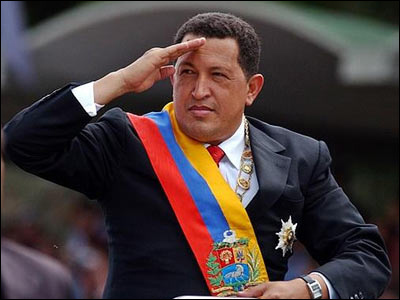
Hugo Chavez has passed away


Venezuelan President Hugo Chavez, a former paratrooper who rose to prominence as the leader of a failed military coup, only to survive an attempted overthrow of his own, has died, Vice President Nicolas Maduro said.
Chavez's death came after a protracted battle with cancer. He was 58.
The fiercely anti-American leader ran Venezuela for 14 years, consistently beating back both domestic opposition and international pressure for years. After winning re-election in October 2012, Chavez' debilitated state forced him to drop out of sight, causing him to miss his own inauguration as he underwent a strict chemotherapy in Cuba.
As his health reportedly worsened, speculation swirled about who was running the country — and who could take Chavez's place in the event of his likely demise.
Chavez disclosed in 2011 that he had cancer yet never publicly disclosed which form of cancer. He had undergone multiple surgeries for tumors in the stomach and reports from Venezuela suggested it may have been sarcoma, a form of soft-tissue cancer.
One of Latin America's last remaining strongmen, Hugo Rafael Chavez Frias was a former military officer was first elected president of one of Latin America's largest petro-exporting economies in 1999. He immediately harnessed Venezuela's vast oil resources – and his broad support among the poor and working class – to tailor his country and the region into an image more to his liking.
The left-wing and often polarizing populist laid claim to a form of governance called "Bolivarianism", which fused Socialist principles with the ethos of Simon Bolivar, a Venezuelan general who championed South America's independence in the 19thcentury. That helped Bolivar to achieve folk hero status,which Chavez used to mold his own pan-Latin American beliefs.
Born in 1954 to two school teachers, Chavez first rose to prominence in 1992 when he spearheaded an abortive attempt to overthrow the government of then president Carlos Andres Perez. The revolt claimed nearly 20 lives, and earned Chavez a two year prison sentence before he was pardoned. He then embarked on a political career that ushered him into the presidency in 1999.
In his efforts to craft a new "Bolivarian Republic," Chavez was a frequent and unapologetic antagonist of the United States, aligning his country with other foes of American interests. In a 2006 speech, he famously took to the stage of the United Nations to liken then President George W. Bush to"the devil", adding that the venue "smells of sulfur."
The roots of his fierce U.S. opposition were sown in the aftermath of the Sept. 11 attacks. The Venezuelan leader denounced the Bush administration's anti-terror efforts, and relations with America reached their nadir in 2002, when a group of opponents attempted to overthrow Chavez's government. After his return to power, Chavez accused the U.S. of covertly engineering the coup.
Until his struggle with cancer prompted him to head to Cubato seek medical treatment, Chavez had not been seen in public since December 11.
His absence from Venezuela in the latter days of his life touched off a wave of political wrangling and court decisions, which culminated in a Supreme Court decision that endorsed a postponement of his inauguration. Members of Venezuela's divided opposition had argued that the constitution demanded a January 10 swearing-in.
His presence in Cuba was a product of medical necessity and political expediency. Longtime Cuban leader Fidel Castro was both Chavez's geopolitical ally and a source of ideological inspiration. Cuba was also a beneficiary of Chavez's petro-fueled largesse, with the country frequently receiving shipments of subsidized oil from Venezuela.
Venezuela has the second largest oil reserves in the world — 211 billion barrels, according to the US Energy Information Administration (EIA).They are the fourth largest supplier to the US, providing 951,000 barrels per day. 
Sunday, March 3, 2013

Fights near Awash kill 60, injure many

By De Birhan Staffer
Addis Abeba
04 March 2013

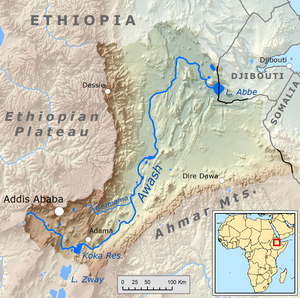
Severe "ethnic and resource" fights among the Afar, Oromo and Somali ethnic groups, near the Awash River, Eastern Ethiopia, have left around sixty people dead and many injured the weekend before (February 23-24, 2013), sources told De Birhan. The fights had also renewed over the week between the Afars and Somalis. 
According to our source, so far 6 from the Somali,  18 from Afar and  36 from the Oromo ethnic groups are recorded dead due to the week long fights. Residents of the area state that they don't know who and how the clash started. 

The region has been prone to clashes over resources such water and grazing land  and also ethnic conflicts by pastoralists of the three ethnic groups.  

Some studies, such as this one by Asknake K. Adegehe (2009), indicate that the cause of these conflicts has been the wrong federalism policy of the current regime,

The federal restructuring carried out by dismantling the old unitary structure of the country led to territorial and boundary disputes. Unlike the older federations created by the union of independent units, which among other things have stable boundaries, creating a federation through federal restructuring leads to controversies and in some cases to violent conflicts. In the Ethiopian case, violent conflicts accompany the process of intra-federal boundary making.
Similarly,  De Birhan had reported that there has been an inter-ethnic clash in the Benishangul Gumz Region of Ethiopia this weekend. 

Saturday, March 2, 2013

Violent clash in Benishangul

By De Birhan Staffer 
02 March 2013

De Birhan's sources in Benishangul region, North West of Ethiopia, are reporting that there has been violent armed clashes in the Region since last night (March 01, 2013). The cause and groups involved in the armed clashes haven't hitherto been clearly identified. The armed clashes between the "unknown groups" has been ongoing at the time of reporting. Some sources are informing De Birhan that the clash is between Gumuz ethnic group and Oromos in Wellega (the former attacking the later). 

Benishangul is the region where Ethiopia is building its Grand Renaissance Dam. The rebel group, Benishangul people's Liberation Movement has been active and involved in various low intensity conflicts in the Region. A faction of the Movement led by Jafar Mustafa signed a peace agreement "to end its 17 years armed struggle"  with the Ethiopian regime on August 2012 in Addis Abeba. 

Benishangul Gumuz Gumuz is one of the 9 regional states in Ethiopia. The region borders the Regional States of Amhara, Oromia, Gambela and the Sudan. The Region has a land area of about 50,380 square kilometers. The Blue Nile River splits the region into two. The population of the region was 670,847 in 2007.  The Region's ethnic groups include the Berta (the largest in number), AmharaGumuzOromoShinasha  and Agaw-Awi (the least). Over 44.98% of the population are Muslim, 33.3% are Orthodox Christians, 13.53% are Protestant, and 7.09% practiced traditional beliefs, according to a 2007  Ethiopian Central Statistical Agency (CSA) data.

Friday, March 1, 2013

Mekelle University President, Vice resign

By De Birhan
01 March 2013

Six days after Dr. Kindeya Gebrehiwot and Dr. Abdulkadir Kedir were reappointed to serve as Vice President for Academics and Vice President for Research and Community Services respectively by Mekelle University Board on 21 February  2013,  the German President of the University, Professor Dr. Joachim Herzig and the Vice President for Support Services, Dr. Dereje Assefa, have officially resigned.  The University's Website stated that the reason for the President's resignation was due to "due to serious health related problems".

There has been intense debate on Ethiopian parliament  academia and media about the presence of serious corruption in Mekelle University over the past four years. Read here here and hereMekele University's Board is Chaired by former guerrilla fighter, Tewodros Hagos who is also the Central Committee member of the ruling TPLF/EPRDF Party is a close relative and friend of Mekelle University's Vice President, Dr. Kindeya Gebrehiwot (former President).

According to a background information available on the Offcal Website of the University, it was officially inaugurated as a University in 2000. At present, the University has eight colleges: Business and Economics, Dry Land Agriculture and Natural Resources Management, Engineering, Law and Governance, Social Sciences and Languages, Veterinary Madicine, Natural and Computational Sciences and Health Sciences; and two institutes: Institute of Pedagogical Sciences, and Paleoenvironment and Heritage Conservation. At present MU hosts over 23,000 students in the regular, continuing education programme and summer, evening, distance education and in-service program in both undergraduate and graduate program.

Dr. Joachim Herzig                                                 Dr. Dereje Assefa
Prof. Dr. Herzig, MU X-President                                     Dr. Dereje Assefa