Sunday, January 29, 2012

Iran invites Meles

* Iran to open Embassies in three Horn of African countries 


By De Birhan Media and Agencies 
29-1-2012


Iranian Foreign Minister Ali Akbar Salehi, who is in the Ethiopian capital attending the African Union summit, invited Ethiopian Prime Minister Meles Zenawi to Tehran to attend the the 6th Iran-Ethiopia joint economic commission meeting which Iran is hosting. 
The Minister also stated Tehran's preparedness to provide African nations, Ethiopia in particular, with necessary assistance for development. Salehi highlighted Tehran's principal policy of promoting relations with the African nations in areas of public interactions as well as economic, industrial and agricultural cooperation. Ethiopia's Hailemariam Desalegn, for his part, lauded the two countries' cooperation as positive, and stressed the importance of preparing the necessary capacities for the two countries' relations. 


President Mahmoud Ahmadinejad's administration has striven hard to maximize Iran's relations with the African continent. Earlier this week, Iran said it plans to set up new embassies in a number of African and Asian states.  


In its meeting here in Tehran on Wednesday, the Iranian cabinet approved a Foreign Ministry's proposal for opening embassies in Somalia, Cameron, South Sudan, Djibouti and the South-east Asian state of Myanmar. 

Tehran has prioritized promotion of its economic and political ties with the African states and the country is now considered as one of the African Union's strategic partners.  Tehran's efforts to boost ties and cooperation with Africa have led to its acceptance as an observing member of the African Union (AU), where it has shown an active presence in the AU summit meetings. 

In a recent research paper that De Birhan Media did, it found  Iran progressively and aggressively mounting its strategic presence in the Horn of Africa. Similarly, most Horn countries and particularly Ethiopia  has been criticised for forming a poly/multi strategic alliance with most strategically interested powers at the same time. 

Saturday, January 28, 2012

News in brief

From ION and agencies

* The Somali Regional State is turning a deaf ear to most recommendations coming from Ethiopia's House of Federations.  

*  After two decades in power, the Ethiopian People’s Revolutionary Democratic Front (EPRDF) has still not been able to bring a lasting peace to certain of the country’s peripheral regions and establish regional administrations that are considered legitimate by the local populations. The Afar region is a case in point. This raises the question, Is Ethiopia a stable state?

* The HIPC initiative brought the Ethiopian foreign debt down in 2008. But since then, it has taken off again, particularly in the second half of 2011.A report from the Ethiopian Ministry of Finance and Economic Development (MOFED) indicates that the country’s runaway external debt has increased dramatically from the total and official 134 billion birr (US$8 billion) at the end of June last year to 200 billion birr (US$12 billion). The document also reveals, the government’s domestic debt has also exceeds well beyond 60 billion birr ($3.5 billion). Total debts amounts to $16 billions.


The foreign and interior ministers of Somaliland have gone to Addis Ababa/Ethiopia to push Ethiopian authorities to stop supporting  Khaatuma State iyo Awdal State of Somalia. Their urgent travel came after Awdal State's president, Rashid Aw Nur Hersi was seen in Jig-jiga airport and Awbarre city inside Ethiopia. The relation between Ethiopia and Somaliland seems to be deteriorating after  President Silanyo had disagreed to remove his "radical ministers" which the Ethiopian government suspects them  of having links with Al shabab. 

Wednesday, January 25, 2012

Two plain reasons why Meles is not worth Premiership - Part I

By T, Staffer of De Birhan Media 
26-1-2012


Meles Zenawi                                        

Addis Fortune gossiped last week that the  current Deputy Prime Minister and Foreign Minister, Hailemaraim Dessalegne could take over Meles Zenawi's position in 2015.
Of a more substantive issue, though, Meles appears to be determined to show people around him that Hailemariam is the man he has settled on to handover the custodianship of the great and all too powerful Ethiopian state, gossip claims.
A former College Dean of Arba Minch University, Hailemaraim Dessalegne has been  in the academic sphere for most of his life. The ascending leader originally from Wolyaeta, Southern Ethiopia, is one of the few top cabinet members who have not fought in the struggle against the military dictatorship of Mengestu. 
Meles Zenawi who quit his University studies as he just turned 20 spent most of his energetic years in the bush fighting against the deposed Derg. When he was 36 he became the President of Ethiopia and Prime Minister at 40 which he has assumed for 20 full years up until now. The dubiously megalomaniac dictator, Meles Zenawi, has some personal characters that his water carriers admire about him. These are people who post his old, agonised, black&white photos and want us to believe he is a superman. They say, at least he has been able to accomplish his missions, however malevolent they might be.  The likes of me, who are critical of him and his regime, would pick countless faults and deficiencies that do not make him eligible enough to lead that big nation. He is a self proclaimed Premier. 

Let me put two plain reasons  why he can't be Ethiopia's premier. More justifications of why he can't/ ought not be a PM will follow in future pieces.

1. He has not been a civil servant/Employee :

Meles Zenawi has never been in public, private or self employment in his life. He has never worked in an office, shop or businessHe has never been on a payroll and doesn't know the bureaucracy.  He doesn't know CPA. He never had a boss. He has never been fired, sacked, redundant, promoted or demoted. He never applied for job, searched for job or wondered about surviving without job.  
He passed the buck of daily tasks to his juniors and rank and files while in Dedebit. Now even worse on the millions of Ethiopians.
Leadership, teamwork, communication, marketing, discipline, time management, project management, client management, meeting targets, etc are all basic skills that public ordinary employees like you and me would garner in our employment years, that Meles hugely lacks.  Hope you won't justify this saying he learnt it in his 4kilo Office. He has never been financially independent. He never paid bills or insurance.  

2. He has not been a Diaspora/emigrant :
I wouldn't argue that being an immigrant or a Diaspora is a prerequisite for being a Premier or President of any country but by Jove, I tell you it is important. A traveller is well experienced and matured than a centred one. Travel is a good school. They call it exposure. Effectively, exposure to democracy, freedom, justice and human rights on the ground. Living it through.
Meles has never been outside his country even for a short while as an emigrant. He never saw other's face (Ye Sew Fit Alayem). He never worked in another man's land. He has never worked as a janitor, kitchen porter or researcher like you and me. Meles has never seen the bullying, discrimination, racism and hate that we have gone through. He has never been able for one day to compare the lives of his employer in the West and his families or neighbours in Adewa, 'cause he's never been a Diaspora. Meles never had a first hand international exposure except via TV and Radio up-until he held the iron fist. He didn't feel sorry for his poor families and compatriots at home and sent them money for holiday and others. He has not learnt about other cultures, integrated and interculturalised himself like you and me pragmatically.
Meles' only employment and Diaspora experiences have been in Dedebit, Maleleit and the Greater Tigray bushes. 

Wind Up

Meles Zenawi at my age would have been inspired by the stories of Che Guevara and Lenin, as my generation would be inspired by the stories of Beyonce and Thierry Henry and crave day in day out to resettle in the West. Both of us struggle. His generation struggled in the bush to reach Emyee Menelik's palace and ours from the city to land in DC. From our cosmopolitan and fancy generation- I see few but glittering youth that would assume the ownership and leadership of the new Ethiopia. These youth have both worked as employees, employers, self employed and lived outside their country. They saw what discrimination means, they have been called names, shouted in the streets Nig**. These are my generation- these are my buddies who now learnt that they have to have a President from Gambella, a wife from Benishanguel and a business partner from Degehabur.  A generation that is ready to make a cultural revolution in Ethiopia saying no to Racism and ethnicity. 
Meles doesn't have those two qualities at least, therefore, he deserves to be our Prime minster NOT! 


Tuesday, January 24, 2012

Addis Fortune Gossips Hailemariam could be the next PM

De Birhan Media 
23-1-2012


The Addis based Business weekly, Addis Fortune in The Fine Line Corridor gossips that the current Deputy Prime Minister and Foreign Minister might take Meles Zenawi's position. 
The signs of Meles’s inevitable departure from and the arrival of Hailemariam Desalegn to Lorenzo Tiezaz Street are beginning to surface, gossip observed. The signs exist in form as much as they do in substance, claims gossip.It is interesting to note that no senior official of this administration – with the exception of the President and the Prime Minister – has as many security details as Hailemariam now has, gossip observed. Most highranking officials, even those who were in a position of Deputy Prime Minister, have no more than two security details and a driver.
Read more  Here

Sunday, January 22, 2012

As tension escalates, Defence Eng. staff on forced leave

By Derese Tariku , Contributor to De Birhan Media
22-1-2012


Addis Abeba- As the tension between Ethiopia and Eritrea escalates following the killing of tourists on the border of the two countries, and Ethiopia has aired a one hour documentary on the State media that accuses and  seeks an "action" on the Eritrean regime. 

Similarily, the Ethiopian Defence Engineering College has also reportedly forced its employees to take a forced leave. 

Sources in the College indicated that the Administration of the College ordered civil servants of the college to take a forced leave, which is a usual happening whenever the Defence Forces ponder to take actions. It was also learned that staff members of Defence Engineering College have been given salary increment. Defence Engineering College is the sole governmental inistitution that trains Ethiopian and other African nation's military cadets in military engineering skills. Sources say Ethiopia may make a  "a dissecting attack" on selected sites in Eriteria.

In a related development, the issues of Eritrea and the current attacks on tourists in Ethiopia's border region of Afar are expected to dominate  the discussions of the 18th Ordinary Session of the Summit of the African Union (AU) scheduled to take place from 23 to 30 January 2012 in Addis Ababa, Ethiopia. 

Addis Abebans called to Kebele meetings


By Derese Tariku , Contributor to De Birhan Media
21-1-2012


Addis Abeba - The Addis Abeba City Administration sent an invitation to residents of Addis Abeba to attend a meeting on "national security" in each of their Kebele (district) auditoriums tomorrow morning (22-1-2012). 
Sources close to the City Administration informed De Birhan Media that the meeting is called specifically to discuss about the recent incident in Afar region that took the lives of five tourist. Last week Gunmen have killed five foreign tourists in Ethiopia's remote northern Afar region. The Ethiopian government accuses Eritrea as the orchestrator while Eritrea says it is Ethiopia's internal matter. 

Similarly, the Ethiopian Television is to transmit a documentary based on last week's tragic incident in Afar entitled "Ye Shiber Abat" tomorrow  after the prime time news.  

Hu Jintao will be in Addis Abeba to give "gift to Africa"


By De Birhan Media 
20-1-2012


" China's gift to Africa" they call it. The new AU Conference Complex will be inaguarted by the Chinese President Hu Jintao who will be in Addis on the 28th of Jan,. 2011. The premises stands on the site of an infamous prison where former dictator Mengistu Haile Mariam executed 60 top officials of the late Emperor Haile Selassie. Former city mayor, Arkebe Okubay granted the land in 2004. China spent a crazy 200million dollar to build the complex. Does the West really worry now about China's immersion into AU/Africa? Jintao in 2007 said, China was building it to "to support African countries in their efforts to strengthen themselves through unity and support the process of African integration."

In this video China Daily's reporter D J Clark visits the new buildings construction,


Saturday, January 21, 2012

Fighting for human rights, neoliberalism? Then make Ethiopia one now

21-1-2012

Ethiopian government was forcibly moving tens of thousands of indigenous people in the western Gambella 
Tedla Desta  
The New Year has popped in jammed with fascinating news items. It kicked off with the joyfully astounding announcement of the Oromo Liberation Front (OLF) to a tragic one that took the lives of five tourists in Ethiopia’s remotest region, Afar and a car accident in the North. This tragic horror, committed by whoever is sinfully insane, was preceded a day before by a news item that gave a good blow to the Meles Zenawi Administration. Human Rights Watch (HRW) said that the Ethiopian government was forcibly moving tens of thousands of indigenous people in the western Gambella region from their homes to new villages under its “villagization” program. It said that these population transfers were being carried out with no meaningful consultation and no compensation and was despite government promises to provide basic resources and infrastructure. The relocations have been marked by threats and assaults, and arbitrary arrest for those who resist the move. Human Rights Watch produced the study after it interviewed over 100 residents affected in the first round of the villagization program in Gambella and found widespread human rights violations at all stages of the program.  A villager in Abobo Woreda, said in an interview with a HRW researcher,

We were told, “If somebody refuses, the government will take action”—so  the people went to the new village—by force.

This and many other research reports, press releases and advocacies were open to the elements from HRW in relation to human rights issues in Ethiopia. All the publications were, by the judgement of this writer, pro human rights, liberty, justice and democracy. These reports have been able to shade lights into what is happening behind the so called “developmental state” of Ethiopia and the glittering buildings of Addis Abeba. In such a time when, all forms of free media and communication have been blocked in Ethiopia creating a condition where both the insiders and outsiders have become unable to communicate and voice what is untold, the reports and statements by HRW are godsend for the millions of voiceless Ethiopians. This internationally reputable organisation is doing a favour to the millions of voiceless Ethiopians by producing cross cutting research reports and leveraging the international community to stand with the powerless and look at the truth than mere strategic interests. The Meles Zenawi regime has always been meddlesome of the HRW reports than any other organisation’s or countries annual reports. In the aftermath of the 2010 Ethiopian National election, the regime forced the city dwellers to demonstrate against HRW in Meskel Square. I remember watching an old lady holding a placard, stuttering to pronounce Human Rights Watch properly and shouting “HRW stop meddling in our politics”.  How many of those in the march knew what HRW does and what it really did?


Response

Like always, the Meles administration responded to last week’s report by HRW by calling it an “ideological campaign” against the government. Meles becomes a revolutionary democrat when he likes and developmental democrat when it pleases him. Thus now he is a developmental democrat who is being “attacked” by the neoliberals.  
The Ministry of Federal Affairs in its response to HRW’s report said this,

These persistent and unfounded allegations of HRW based on its neo-liberal ideology will not deter Ethiopia from pursuing in its development path.

The statement also said the hostility of Human Rights Watch emanates from the market fundamentalism ideology advocated by neoliberals which Ethiopia does not accept.  Following the 2005 election, the Meles regime had two distinct enemies that it continued to savagely do violence to. These are neoliberals and rent seekers. The Ethiopian government had always argued against HRW’s reports by saying that they are “Newoliberalsit” campaigners who waged warfare against the “Developmental Democracy” Ethiopia. In short, HRW aspires to change Ethiopia into a newoliberal state, they say.
In line with the above outlook, a very recent EPRDF file called “The Strategic Significance of Election 2010” states,

Though rent-seekers of our country took on this confusion from their manipulators and fanned it after the election, this confusion had been widely spread by the fundamentalist neo-liberals prior to the election. In this respect the statements issued by the major proponent of this campaign, Human Rights Watch, before the election and on the morrow of the election can be taken as typical proofs for this. Moreover, one can easily guess that the conclusion of the EU Observers is the result of the pressure exerted by these fundamentalist neo-liberals. The attempt of the officials of Human Rights Watch to speak to and coax the leaders of the EU Observers is a public secret. So it should be underscored here that the campaign involved many actors, including the Human Rights Watch, and our rent-seekers who joined the band wagon late is an integrated one and would further be consolidated in the future to belittle the democratic victory of the people.

The file further continues and attests that HRW and the Eritrean government have been working to create a copycat of Darfur in Ethiopia’s eastern region, the Somali Regional State. This is with regards to the 2007 reports by HRW regarding alleged “genocide” and human rights abuse in the Region.

As is well known, the high expectation of forces such as Shaebia and the Human Rights Watch as well as local anti-peace forces to create an Ethiopian Darfur by consolidating anti-peace forces as never seen before and by simultaneously conducting wide campaign in the name of human rights concentrated on the problem in Somali Regional State. Their strong wish and expectation that the situation in the state would get out of control and become a huge problem similar to Darfur in the Sudan proved futile.

In a 2010 article on the EPRDF website titled “Revolutionary Democracy: A fitting Worldview for economic and political development in Ethiopia”, Adal Isaw shows his own and his party opposition to liberalism and newliberalism in a Lenisit undertone as such,

Revolutionary democracy rejects the philosophy of aggrandizing the individual as if he or she, by uncoordinated design, is the source of economic and political development.  Political and economic development is the result of a planned collective effort, not the result of a spontaneous interaction of self-seeking individuals.  For all these aforementioned reasons then, revolutionary democrats are cognizant of the fact that the arduous work to build a middle income democratic Ethiopia will be nearly impossible; one, if and when it is based on a liberal worldview that favors the unfair and controlling economic and political interest of the Western world; and two, if and when it is based on economic and political philosophy that exaggerates the inalienable rights of a self-seeking individual.

In a similar manner, Meles Zenawi in a recent academic paper titled ‘States and Markets: Neoliberal Limitations and the Case for a Developmental State’, 2012 contained in a book titled ‘Good Growth and Governance in Africa: Rethinking Development Strategies’ and published by Initiative for Policy Dialogue scrutinised the “theoretical and conceptual limitations of neoliberal paradigm and the need for Africans states towards becoming developmental”.  Echoing Joseph Stieglitz’s market fundamentalism and anti-neoliberalism concepts, the 34 page paper by Meles bashes neoliberalism as an ideology that 'fosters rent seeking' and lauds 'his' Developmental State Paradigm that “accelerates growth and limits socially wasteful rent seeking''. Last month, Head of the Government Communications Affairs Office (GCAO), Bereket Simon in his interview with Tefera Gdamu of Ethiopian Television said "The mother of all problems in Ethiopia is rent seeking."

Generalising and arresting local opposition and critics under the umbrella of “rent seekers” and foreign and Diaspora based critics as “fundamentalist neo-liberals” has become the game of the day. In this century, when the war of ideologies has died out, EPRDF/TPLF is now up in hostilities with its own ideological ‘enemies’ – the neoliberals.

Definitions

With the academic and political debates and arguments held aside, let’s read what the definitions of these chunk words mean. Many writers agree that Neoliberalism originates and shares aspects of liberalism which as to the Oxford English Dictionary (1989) is a political ideology which is “[f]avourable to constitutional changes and legal or administrative reforms tending in the direction of freedom or democracy”. Neoliberalism is a modified or revived form of traditional liberalism, [especially] one based on belief in free market capitalism and the rights of the individual” (Oxford English Dictionary, 1989a).  Libertarianism on the other hand is typified, as its name suggests, by a remorseless concern for liberty above everything else, especially economic or commercial liberty, coupled with a corresponding de-emphasis of other traditional liberal purposes and values such as democracy and social justice. This sets libertarians apart from many earlier classical liberals such as Smith and Tocqueville who, while they vigorously advocated quite extensive economic liberties, also acknowledge the validity and legitimacy of other concerns.
Neoliberalism promotes the ownership of the economy by the private sector than public or reduced state interventionism. Its policy proposals such as mainly of removing large deficits, redirected pro poor and growth public spending, trade liberalisation, privatisation of state enterprises, deregulation and similar others has gained momentum with many international organisations and countries.
Rent-seeking generally implies the extraction of uncompensated value from others without making any contribution to productivity. The origin of the term refers to the gaining control of land or other pre-existing natural resources. In the modern economy, a more common example of rent-seeking is political lobbying to receive a government transfer payment, or to impose burdensome regulations on one's competitors in order to increase one's market share.
The above definitions are not conclusive and broad enough; however they can give some clue about the terms and their relationship. Now putting the above academic definitions on the plate, let us assess what HRW really does. We do this by directly reading what HRW does and its missions are;

Human Rights Watch
HRW is one of the world’s leading independent organizations dedicated to defending and protecting human rights. By focusing international attention where human rights are violated, it gives voice to the oppressed and holds oppressors accountable for their crimes. HRW’s rigorous, objective investigations and strategic, targeted advocacy build intense pressure for action and raise the cost of human rights abuse. For more than 30 years, Human Rights Watch has worked tenaciously to lay the legal and moral groundwork for deep-rooted change and has fought to bring greater justice and security to people around the world, according to the official website of HRW.
HRW Mission

Human Rights Watch is dedicated to protecting the human rights of people around the world. We stand with victims and activists to prevent discrimination, to uphold political freedom, to protect people from inhumane conduct in wartime, and to bring offenders to justice. We investigate and expose human rights violations and hold abusers accountable. We challenge governments and those who hold power to end abusive practices and respect international human rights law. We enlist the public and the international community to support the cause of human rights for all.
Be a neoliberal
Since writing of his “African Development: Dead. African Development: Dead. African Development: Dead Ends and New Beginnings”, Meles and his apostles started to utter the words of development, transformation and growth as the primary goals and missions of the government while sliding from their initial Revolutionary Democracy ideologies, human rights, democracy and freedom mantras. They squarely put the failure of African economies as the responsibility of “neoliberals, rent seeking and neoliberalism”. As can be comprehended from the above paragraphs, there is no single line or connotation that evidences HRW is a neoliberal institution or campaigns it taking it as its mission. In spite of this, the Meles administration prefers to label the rights group as a neoliberal organisation albeit it is rarely that we hear entities or persons tagged a “neoliberal” like we habitually say a “liberal” or “libertarian”.

Therefore, if defending and protecting human rights, upholding political freedom,  protecting people from inhumane conduct in wartime, bringing offenders to justice and challenging abusive governments is neoliberalism as the Meles’ love to hallucinate it, why not Ethiopia be a neoliberal nation and we also be neoliberals? Yes if human right was abused, injustice prevailed and repression reigned with the developmentalist state paradigm as we are witnessing now, why not we be Neoliberals?
Yes Neoliberals of the world Unite!

The writer can be reached at tedanagi26@yahoo.com

Friday, January 20, 2012

Libyan Prime Minister to attend AU's Summit in Addis Abeba

By De Birhan Media 


20-1-2012


                                                  Libya's interim prime minister Abdel Rahim al-Kib 


For the first time since Gadafi's fall, Libyan Prime Minister Abdel Rahim al-Kib, with whom he held talks, would take part in an AU summit scheduled for the end of the month in Addis Ababa, AU Commission Chairman Jean Ping said. The 18th Ordinary Session of the Summit of the African Union (AU) is scheduled to take place from 23 to 30 January 2012 in Addis Ababa, Ethiopia.


Thursday, January 19, 2012

Ethiopia terror convictions an ‘affront’ to free speech


Amnesty International 

19-1-2012
Journalists Reyot Alemu and Woubishet Taye have been convicted after criticizing the government.
© Private
The convictions are yet another sign that individuals who hold different opinions are no longer tolerated in Ethiopia.
Claire Beston, Amnesty Internationa's Ethiopia researcher
The Ethiopian authorities must immediately release four government critics and a former opposition supporter who have been found guilty of terrorism charges on Thursday, Amnesty International said today.


Journalists Reyot Alemu and Woubshet Taye, opposition party leader Zerihun Gebre-Egziabher and former opposition supporter Hirut Kifle, were found guilty on terror and money laundering charges. Journalist Elias Kifle, now based in the US, was also found guilty in absentia. 


"This is an affront to freedom of expression. The convictions are yet another sign that individuals who hold different opinions, represent different political parties or attempt to provide independent commentary on political developments, are no longer tolerated in Ethiopia," said Claire Beston, Amnesty International’s Ethiopia researcher.

“There is no evidence that these three men and two women are guilty of any criminal wrongdoing. We believe that the five are prisoners of conscience, prosecuted because of their legitimate work and peaceful activities and they should be released immediately,” she added.


The five were found guilty on three charges: ‘Planning, Preparation Conspiracy, Incitement and Attempt of Terrorist Act’, Participation in a Terrorist Organisation’ and ‘Money Laundering’. Journalists Woubshet Taye, Reyot Alemu and Elias Kifle have all written articles critical of government policy and practice, while Zerihun Gebre-Egziabher, the president of the Ethiopian National Democratic Party, has written statements on behalf of his party which were critical of the government.  Shortly before his arrest in June last year, the opposition leader had also requested permission to stage a political rally on 28 May in central Addis Ababa. Hirut Kifle was jailed in 2007 for alleged involvement with an armed group, while she was a supporter of the opposition Coalition for Unity and Democracy, before being released by Presidential pardon.   


Much of the evidence presented by the prosecution during the trial related to the defendants exercising their right to freedom of expression and association. This included numerous articles written by defendants,and even articles sent to them by other people.  A substantial proportion of the evidence against the defendants related to their reporting of, and alleged involvement in, the appearance of the slogan Beka! (“Enough!”) in locations around Addis Ababa in early 2011, as a call for peaceful protests against the government to take place on 28 May.    

"This focus of the prosecution's evidence illustrates that free expression has been criminalised in this trial, and that criticising the government is considered a crime," said Claire Beston. 


The court and pre-trial proceedings were also marred by numerous fair trial concerns. Both Woubshet Taye and Zerihun Gebre-Egziabher complained in court that they were severely beaten while held at Maikelawi detention centre in Addis Ababa, which is infamous for the frequent use of torture against pre-trial detainees. No investigations into these allegations have been carried out. Woubshet Taye and Reyot Alemu were both forced to reveal their e-mail passwords during interrogation in Maikelawi. Contents of the e-mail accounts were presented as evidence against them in court. Woubshet Taye also complained that e-mails from his account had been changed, and some were falsely interpreted. 


Reyot, Woubshet and Zerihun were denied access to family members for the first month of their detention in Maikelawi and were held in isolation cells during the initial stages of their detention. Hirut Kifle was reportedly denied access to family members for three months when she was first detained.  In October, Woubshet Taye and Zerihun Gebre-Egziabher were informed that their visiting arrangements had changed. Since then, visitors have only been permitted to visit the two men for ten minutes per day. Since March 2011 at least 107 opposition party members and journalists have been arrested and charged with various offences under the Anti-Terrorism Proclamation and Criminal Code. Last month two Swedish journalists were convicted of terrorism offences and sentenced to 11 years’ imprisonment.

Tuesday, January 17, 2012

ኢትዮጵያ፡ የግዳጅ ሰፈራ ረሃብ እና ችግር ያስከትላ


***ጉልህ ምስሎችን ለመመልከት http://www.hrwnews.org/press/ethiopia_gambellavillagization.zip ይጎብኙ


የለጋሾች ገንዘብ ተወላጅ ሕዝቦችን ለማንገላታት መዋል የለበትም 
(ለንደን፣ ጥር 9 ቀን 2004 ዓ.ም.) – “ሰፈራ” በመባል በሚታወቀው ፕሮግራሙ የኢትዮጵያ መንግስት 70,000 የሚደርሱ የምዕራባዊ ጋምቤላ ተወላጆችን በግዳጅ በማፈናቀል በቂ የሆነ ምግብ፣ የእርሻ መሬት፣የጤና አገልግሎት እንዲሁም የትምህርት ተቋማት ወደማይገኙባቸው አዳዲስ መንደሮች እንዲሰፍሩ በማድረግ ላይ ነው ሲል ሂዩማን ራይትስ ዎች ዛሬ ባወጣው ሪፖርት ገለጸ። የግዳጅ ሰፈራውን የተቃወሙ የአካባቢው ተወላጆች በመንግስት የጸጥታ ሃይሎች ተደጋጋሚ ማስፈራራት፣ድብደባና ሕገወጥ እስራት ተፈጽሞባቸዋል።

Skirmish in Afar region

Afar Regional State 


By T, De Birhan Media Staffer 


17-1-12

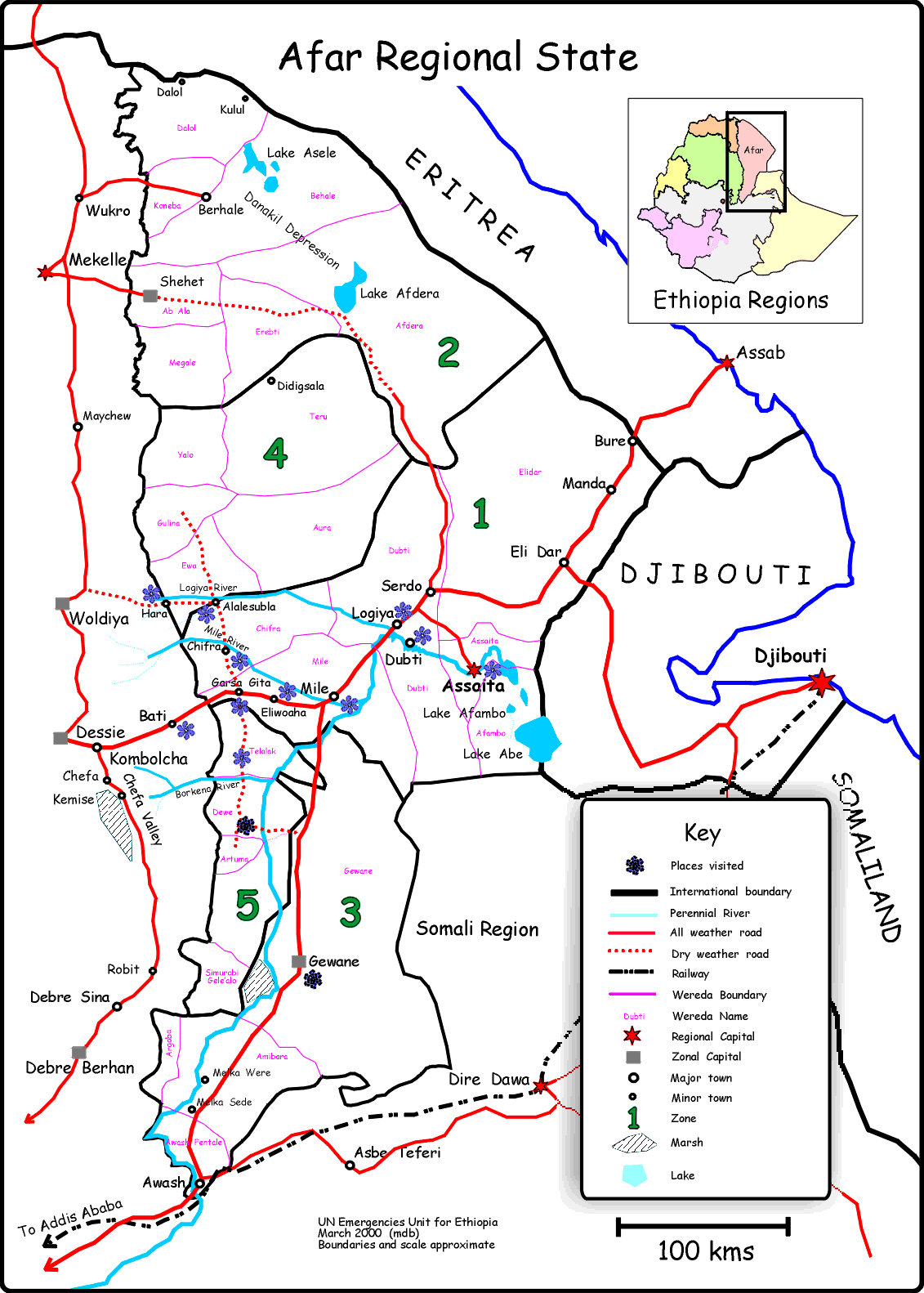
A skirmish between unidentified insurgents and the Ethiopian Defence Forces  in
the Afar Region of Ethiopia bordering Eritrea has taken the life tourists who were
visiting the region. 
The skirmish happened last night (16 January 2012) in Ertalee, Denakil Depression . 
Five tourists have been killed while two were seriously wounded
and one was unhurt. The number of soldiers killed in the fight is not known yet.
According to the German based media, bild.de a German and an Austrian were 
killed while one other German was kidnapped. It also reported that the 25 member
 team of the tourists included Germans,Austrians,Italy, USA, Australia and two 
Ethiopian nationals. Two were kidnapped while 18 were safe unharmed. 
The Ethiopian government alleged that the

Sunday, January 15, 2012

News Briefs

Compiled from ION and other agencies 
15 Jan 2012

The Canadian junior mining company Allana Potash has decided to sell 25 million shares to a group of buyers that is led by Dundee Securities Limited.Allana Potash (TSE:AAA) said Wednesday that it has signed an agreement for a $20 million bought deal financing, proceeds from which will be used to complete a definitive feasibility study on its Dallol potash project in Ethiopia.
The agreement with a syndicate of underwriters led by Dundee Securities consists of the purchase of 25 million common shares of Allana Potash, at a price of 80 cents each, on a bought deal basis.
The company has also given the underwriters an over-allotment option to increase the size of the offering by up to an additional 3.75 million common shares, or up to $23 million in gross proceeds. The option is exercisable anytime before 30 days after the closing of the bought deal financing, which is expected around February 2, subject to regulatory approvals.
Allana said the new funds will be used to complete the definitive feasibility study for Dallol, as well as for working capital and other corporate purposes.bThe Ethiopia project also hosts shallower deposits, which means the company is not required to drill that deep, allowing for cost savings, Abasov told Proactiveinvestors in December.
The company is planning to start production at Dallol with one million tonnes at the initial stage by 2015, to reach peak production by year 2017. Start of construction at the project is anticipated as early as late 2012, with minimal output expected by the end of 2014. Based on recent positive drilling results in the western portion of its concession and the positive PEA, Dundee Capital Markets assigned the company a "Top Pick" rating and a 12 month price target of C$2.00, while Fraser Mackenzie rated Allana as a "Strong Buy" with a target price of $1.65.


Somaliland President Ahmed Mohamed Mahamoud Silyano has appointed a young officer trained in an Ethiopian military academy to head the intelligence services.The President appointed Mr. Jama Mohamed Botan, a recent graduate from Ethiopia military college with several years of intelligence experience as the head of the organization. It was reported that Somalialand police had intercepted and detained a large truck carrying various light firearms and live ammunition in the Las Geel district last week.


+The Ethiopian ministry of agriculture is against the firm Karuturi’s plan to install thousands of Indian farmers in land it has leased in the Gambela region.The Indian company Karuturi Global Ltd, which has been cultivating roses in Ethiopia since 2004, is now in conflict with the Ministry of Agriculture and Rural Development (MoARD) about one of its expansion projects. This firm, which is headed by Ramakrishna Karuturi,    obtained an allocation of 300,000 hectares (about 740,000 acres) in Bako in the Gambela region, south west of Addis Ababa for an ambitious agricultural project to grow crops like maize and oil palm, involving an investment of over $1 billion. It wants to install Indian farmers on a tenant arrangement on one fifth of the 100,000 hectares of which it has already taken possession. But MoARD is against this scheme.


At the end of 2011, a few hundreds of Indians, presented as operators of agricultural machinery, arrived in Ethiopia and Karuturi asked the Ministry of Labour and Social Affairs (MoLSA) to issue them with work permits. MoLSA then consulted MoARD which opposed the attribution of these work permits, deeming that these Indians were future tenant farmers hired by Karuturi. The latter then stated that these Indians would not be hired as farmers but as technical consultants to put the land into production. Nevertheless, in their negotiations with Karuturi, the MoARD officials demanded the Indian company to send these workers home, because Ethiopian legislation only allows work permits to be issued to foreigners when local manpower is insufficiently qualified for the relevant jobs.