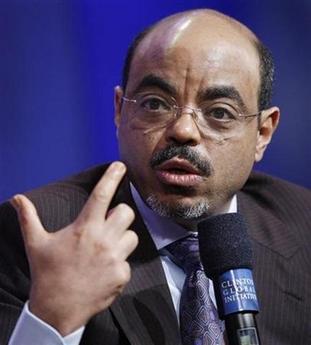
The disappearance and health situations of Ethiopia’s top admin, Prime
Minister Meles Zenawi and the political ‘uncertainties’ it created in the
country is affecting the economy and foreign direct investment.
According to some foreign investors in Ethiopia that De Birhan spoke to, the political uncertainty and instability that was
created due to the Prime Minister’s health and tensions that it resulted,has “worried and unsecured” existing and potential investors from making further investment in the country.
Foreign investors engaged in various investment sectors are following
the Prime Minister’s situation very closely, said an Asain investor investing
in the tertiary sector in Addis Abeba.
The impact of Meles’ illusive health situation on the economy
has been particularly observed in the agricultural sector. According to one
investor, “international agricultural
investors already in the country have all stopped investing about $200m. And those who are already in the country and
have big plans don't have money.”
Asked if the
political uncertainty has also impeded more foreign investors from coming in to
invest in the agricultural sector, the investor added “Other agricultural
investors that were potentially coming to the country with over $500m have changed
their mind due to the political uncertainties”.
A literature
review finding on the impact of political insecurities and instability on national economies and investment written by Morikawa Masayuki on March 27, 2012 issue ofthe Weekly
Economist, states asgreater
policy uncertainty raises the value of waiting to invest and consume until it
is resolved, they (investors) become more cautious and hold back on investments
and consumption.
Morikawa says “a
number of growth regression analyses in many countries have been carried out
since the 1970s regarding the relationship between political stability and
economic growth. In the early 1990s, Robert J. Barro showed in his paper that
variables to measure political instability such as the number of revolutions
and political assassinations negatively influence economic growth and
investments.”
Similarly, the
International Monetary Fund's (IMF) economists working paper analyzing the
relationship between the frequency of cabinet changes and economic growth using
panel data covering 169 countries found that after controlling for the ordinary
determinants of economic growth—such as education level, population growth, and
degree of openness to international trade—an additional cabinet change a year
reduces the annual real GDP per capita growth by around two percentage points.
Meles Zenawi has not been in his official function and
vanished from public view for over 40 days now. The gobenment had admitted that
he was in fact “sick but recovering now”. Ethiopian Satellite Radio and Television
(ESAT) Radio reported yesterday that Meles Zenawi had already passed away.
Meles Zenawi has not come out on a live TV to refute
the reports.
The Prime Minister’s absence caused political uncertainties
in the country and fears that this might possibly lead to political turmoil.
Ethiopian Satellite Radio and Television (ESAT) just reported in its tonight news that Ethiopian Prime Minsiter Meles Zenawi has died at 57. The Radio cited its sources from an international organisation and the diplomatic community. One of the organisations in the News Report cited in the report however, said it "is not in a position to speculate about the fate of PM Meles Zenawi, nor have we commented on it to date." on Twitter.
He graduated from the General Wingate high school in Addis Ababa, then studied medicine at Addis Ababa University (at the time known as Haile Selassie University) for two years before interrupting his studies in 1975 to join the TPLF.Meles Zenawi acquired an MBA (Master of Business Administration) from the Open University of the United Kingdom in 1995 and an MSc. (Masters of Science) in Economics from the Erasmus University of the Netherlands in 2004. In July 2002 Meles received an honorary doctoral degree in political science from the Hannam University in South Korea, according to file on under his name on Wikipedia.
De Birhan has however been informed by its sources that Meles Zenawi was visited at his hospital by members of the Ethiopian Embassy in Brussels last week. They did not say whether he was alive or dead.
It was around 11pm when
I reached home and was hosted by the contemptuous face of my mom. After giving
me a lackadaisical hi, she went back to her reading. I hollered “give me my
supper!”
Yes unlike today when I
am making tasteless spaghetti as bachelor, my mom used to feed me her delicious
hands.
“Ok let me finish this”
she replied.
“Is this guy not afraid?”
she asked while gently folding MenelikNewspaper, one of the most read chain
of newspapers that Eskinder had owned.
“Who?” I queried.
This journalist called
Eskinder Nega. “Oh, Mary I was so frightened for him reading this bold
statements that might jeopardy his life” she whispered.
My mom is not a lukewarm
reader. She reads no matter what is written on piece. Influenced by her reading
therefore, whenever she discussed about any issue with us, she often used this phrase
to authenticate her points, “according to an international study”.
So I and my sis used to
take a piss and joke on her whenever she made some claims or declarations that
don’t make our day during chats, saying who told you this “is that according to
an international study?”
One evening, while we
were dining, she began gossiping about her favorite neighbor. “I heard Mrs. X
is soon to head to the U.S. to visit her daughter” she set in motion. I then asked
“who told you?”
My naughty sis quickly answered
“She learned it from an international study”. Hahahaha
Her favorite papers
mainly come from Abegaz Suk (Abegaz Kiosk). Abegaz is a slim friendly shop
owner in our neighborhood who supplies us with our retail needs. Our morning
breads, fruits, vegetables and other groceries came folded in newspapers and
magazines from his shop. All kinds of papers that are sold in the market ranging
from the international Time, State
owned, Addis Zemen to the defunct privately
owned, Menelik newspaper are at the
end of the value chain used as folders and bags by these kiosks.
Abegaz was one source
of her favorite papers. The second was my dad. She urges him to come back with
a couple of Newspapers every afternoon he goes to a night out to chill with his
colleagues.
Hence each time she
read Amharic papers, she first went to pages that had Eskinder’s byline. She
was addicted to his assertively authoritative write ups. The time was pre-2005.
She often admired him for speaking the truth and being so valiant. A student then,
I read few newspapers than herself. I used to hear about Eskinder from my mom’s
weekly reviews.
Fast-forward
2007
I am not one of
Eskinder’s closest friends. I met him a few times in various press conferences
and meetings around the 2005 election but we never had a time for a long chat. In few
of the occasions that I met him, he unchangingly approached and talked to me
with great humility, respect and humbleness. Eskinder has a superbly personable
disposition.
I have two special personal
memories of him. The date was when journalists and leaders of Collation for
Unity and Democracy (CUD) were freed. I was going door to door to the houses of every CUD leadership
with a photojournalist friend. The first house that we went to was Engineer
Hailu Shawel’s.
We knocked.
Two men standing in the door, opened and said “what
do you want boys?” We told them who we
were and that we wanted to congratulate the Engineer and speak to him. With a
mocking face the guards said, “You have no appointment so you cannot get in”. We
begged, beseeched, joked and all. No chance. While we were discussing about
going to Dr. Berhanu’s house instead, Eskinder Nega suddenly came out of the
house with few friends. He said hi guys how are you? Any problem? We explained
ourselves. He returned to the house and came back with Hailu Sahwel’s son who
finally let us in. We thanked Eskinder, got in and did our job.That was one of Eskinder’s invaluable favors
to me. One.
The second time I met
Eskinder was in a private Secretarial Office in Piassa while he was working on
his draft book. I had good bit of discussion with him then. It was at this moment
that I came to learn the dictatorialness of the regime and the braveness of
this principled gentleman much more empirically. That was the second and last
time I met Eskinder.
After graduating in one
of the most prestigious schools in Addis, Sanford and living most of his adult
life in the United States, Eskinder returned with a second degree to the country
he loved most and paid his flesh and bone since, Ethiopia. It would be difficult
to find any Ethiopian journalist or African, in that case, who has paid so much
sacrifice for what he believed in. He was slapped, kicked, harassed,
intimidated, and tortured several times in the last 21 years. He was imprisoned
over 7 times.
Which politician, journalist,
human rights combatant has endured what Eskinder had stomached? Didn’t all
our opposition leaders flee as soon as they got freed at once? If we speak of
any negligible civilized resistance, grilling and watchdog on the incumbent in
the past 21 years, no political party or politician did do as Eskinder
Nega’s pens.
Eskinder’s health and physique
have been injured by the prisons of Ethiopia but his spirits. Comparing his
photographs before 15years and now illuminates his torment. Those of you, who
spent a day or two in an African prison, do feel it in your nerves when the
term is mentioned. This prisoner of conscience, if freed tomorrow morning, won’t
run away like the rest of us but dice with death for the sake
of his belief and profession. BTW, how many of us are helping his wife and son when the breadwinner is now in prison?
If I was asked to put
my views about Eskinder, this was what I perhaps would have said “Eskinder
has an indomitable spirit and principle; he is a superman and an icon to
Ethiopia’s youth.” I grin like a Cheshire cat because I hail from a land that has
produced journalists and figures sharp as a tack as Eskinder.
I just cannot get
enough words to explain about Eskinder’s individuality. May I just wish him
freedom!!!
Now suffering in Kaliti prison, Ethiopia, Eskinder is one
of the five Ethiopian internet bloggers sentenced for terrorism few weeks ago.
Ethiopia has now between
150 to 200 blogs and bloggers. Let’s make 1000 Ethiopian blogs and bloggers
before September 2005/2012!!! Yes we can!!!
De Birhan Media's staffer produces today's cartoon lookalike lampoonery of Ethiopian Prime Minister Meles Zenawi who has vanished from the face of the earth for around 40 days now.
By T and Derese Tariku, Staffers of De Birhan Media Negele Borena, Addis Abeba
27 July 2012
Moyale and its boardering towns
The town of Moyale had fallen under the control of an unknown militia force who attacked the town yesterday. The militia
burned down the police station and the Customs Office. Over 50 people have reportedly died and hundreds have been taken to Yabello and Negele hospitals. A
Commander of Oromia Special Police who was sent to reinforce the town as
well as four local police were killed. The Ethiopian military
stationed at 'Shawa Ber', 2 Km from the town, conspicuously watched as
the town was being burned down.
There are sources who stating the cause of the clash as being "ethnic between the Borena and Begri as usual" while others say it was a political take over. Somali and Oromo ethnic tribes have always attempted to take hold of the town, source adds. Witnesses are reporting that they have heard religious chants by those who were marching to the City's main Bus Station.
Doctors in the area told De Birhan that the situation has been bad. Fighting still ongoing and
rumors of anunknown militia force "controlling the town of Moyalle". He said that injured people are still coming to hospital. The road to Moyale has been closed.
Two helicopters from Kenya are hovering the town.
Another source just informed De Birhan that the Ethiopian armed forces have now intervened and are arresting all that they find in the town. Several people have gathered around Fekadu Hotel in the town, looking for deceased and injured relatives.
Moyaleis amarket townon the border ofEthiopiaandKenya, which is split between the two countries: the larger portion is in Ethiopia (in theOromia Region), and the smaller is in Kenya (the capital of theMoyale District). There are four disputed locations within the Moyale district between the Somali and Oromo regions.
Oromo Liberation Front
(OLF) which is led by General Kemal Gelchu and ALEJE, Alliance of the three organizations (Afar People
Party, Ginbot 7 Movement for Freedom, Justice and Democracy, Movement for
Ethiopian Unity and Justice) agreed to cooperatively work
towards removing the incumbent regime in Ethiopia, a press release
attests.
In their
joint communiqué releasedon the 22 July 2012, in addition to their
previous deals, the two organs agreed to work on five main points such as:
The source of all political powers, at local, at regional or Federal
levels, shall be fair and free elections.
The federal system to be established shall be real and genuine.
They shall use all forms of struggle that are timely and possible to
remove the TPLF rule.
A transitional provisional government that will be established shall be
composed of all political and civic organizations.
All the aforementioned activities shall be conducted in a country that
is known as sovereign Ethiopia.
The statement further
added, “As we have always been expressing our commitment to the main and
cardinal principles of the struggle of the Ethiopian people without any
equivocation in the past, ALEJE and OLF have reaffirmed their sincere
commitment and pledge to continue on the same path until the TPLF rule is
removed and replaced by democratic order.”
In such a time, when Meles Zenawi, the Commander -in- Chief and Prime
Minister of Ethiopia, has been absent
from his posts and the media for over 35 days now, most Ethiopian media and
activists are “
demanding all opposition forces to come together”, and stand-in if
crisis might arise due this power vacuum.
De Birhan is collecting data to produce a long research material
or in-depth reportorial on crisis between the government and Ethiopian Muslims.
Over the course of the past two weeks alone, massive protests by Ethiopian
Muslims rocked the capital, Addis Abeba. The regime consequently arrested
scholars and activists that it said are “extremists and behind the protests”.
This created a bigger standoff. It will
be a study that will broach the issue from historical, present dynamics,
political aspects of the religion, and government’s role in the crisis, media,
chat rooms, international (external) and other players. In the mean time, De Birhan suggests this short conflict
analysis/mediator piece forward. The
analysis is done by using Christopher W. Moore’s (2003) book titled “The
Meditation Process: Practical Strategies for Resolving Conflict” as a
conceptual framework.
Conflict Analysis
Is the synthesis and interpretation of data collected by mediator from
interviews, direct observation, or examination of secondary sources. The
mediator’s central task during this stage is to integrate and understand the
elements of the dispute: people, dynamics, issues and interests.
1. 1. Data
About people: names
of potential and past interviewees and organizations associated with and involved in the conflict.
From the Ethiopian Muslims Arbitration Committee: Abubeker Ahmed,
head of an independentIslamic arbitration
committee.
Ustaz Ahmedin Jebel,
Ustaz Ahmed Mustefa, Ustaz Abubeker Ahmed,Ustaz Ahmedin Jebel, Ustaz Ahmed
Mustefa, Alim Dr. Jedolani Hedir, Dr. Abdela and Dr. Kemal.
From the Official Islamic Council, Sheikh
Ahemedin Abdualhi.
Leadership of Al-habash both inside and outside of
Ethiopia.
From the Government: Meles Zenawi, Redwan
Hussien, Dr. Shiferaw Tekelemariam, Getachew Assefa, Yehdego, Werkneh Gebeyehu.
For the moment the people that are at the
center of this act are those listed above. The people also represent their
respective organizations.
1.1The causes: The
regime alleges the current tension and conflict that it is having is induced by
few “extremists group” and that they don’t represent the critical mass. On the
other hand, the Arbitration Committee that has the support of the Muslim mass who often attend protests that it organizes says it is "airing the voices of the
majority of Ethiopian Muslims".
According to Awolia.com , a pro Arbitration
Committee Website “Muslims are demanding
rightful ownership of Islamic council (Majlis), an institution that supposed to
represent them and their interest. The incumbent leaders of the Majlis are
unknown to the Muslims, and they are considered illegitimate as they are not
elected. No election was held since 1997 Ethiopian Calendar, and the Majlis is
often accused of acting against the interest of the Muslims. Muslims want to
win back the Majlis (Islamic council), and their constitutional right to
elect their representatives respected.”
Data about relationships and
dynamics: The following triangular
figure shows the three top actors in the current standoff.
The relationship
of the conflicting parties: the conflicting parties can be depicted in three
dimensions however the polarization is bi meaning that there are two poplars in
adversary. The regime and the Council/Ahbash on one side while the Arbitration
Committee with millions of supporters and worshipers on the other. The relationship between the former is of
symbiotic and “political”. The government appoints the leaders and members of
the The Ethiopian Islamic Council. Similarly, Al-Ahbashalso known as theAssociation of Islamic Charitable Projects
although started by an Ethiopian scholarAbdullah al-Harari, came into Ethiopia through
“the invitation of the Ethiopian government and the Islamic Council.”
The
current Al-Ahbash
teaching which is resented by the Arbitration Committee and its followers is one major polarizing issue. On the opposite side of the continuum is the
Arbitration Committee. The 17 member Committee, mostly composed of Muslim
scholars has been established to find a solution to three main areas of
conflict: free and fair election of Islamic Council Members and Awolia
School, ceasing of the “promotion and teaching of Al-Ahbash and
complete stoppage of government interference in the religious affairs of
Ethiopian Muslims”.
A grasp of historical events and trends that have led to the present conflict: The history of the current Ethiopian regime and Ethiopian Muslims has broadly speaking been cordial and positive. The current regime had allowed religious freedom “better than” previous regimes. Many religious denominations and sects developed in the nation. Various sects and teachings of Islam have also bred.
The regime at various occasions claimed “an extreme sect of Sunni Islam called Wahhabism has penetrated Ethiopia” and it even alleges the burnings of Christian churches and current massive movements to “Wahhabists”. In fact, a Winileaks cable filed on2009-07-15 by the then U.S. Ambassador to Ethiopia, Donald Yamamoto reports “Arab Wahabi missionaries, mainly from Saudi Arabia, continue to make inroads into the Ethiopian Muslim community, but are meeting increasing resistance in doing so”.
The sudden measures that the government took in firing Awolia School teachers and taking over the school administration, introduction of Al-Habash teachings specifically lead to the current tension and conflicts.
Development of conflict relationships: timeliness and case study scenarios:
Timeliness:
- Late 2011/ 2012 – large scale protests by
Ethiopian Muslims every Friday at Anwar Mosque, Addis Abeba
- 2010/11 Actions by the regime. Reorganizing Awolia School and
reshuffling staff members. Beginning of the teaching of Al-Habash to Ethiopian
Muslim clerics and mosques.
-In
2009/10....Founding of a Discussion forum called "Ethio Muslims Interfaith
Dialogue for Justice" and various media on Islamic issues: Bilal
Communications and Badr Broadcasting Network and Africa TV.
- 1996
to present – sporadic cases and reports of the burning of mosques and churches.
- 1991
to present- Intensification and entrenchment of Islamic sects, teachings and
scholarships in Ethiopia. Government has been cooperative all the way up until
recently.
Case Study scenarios:
Ethio Muslims Interfaith Dialogue for Justice
(EMIDJ)
In 2009/10, an online discussion forum called
"Ethio Muslims Interfaith Dialogue for Justice” was opened to discuss
issues of concern of Ethiopian Muslims. This writer has been attending the
discussions on and off since then. Participants at the start highly criticized previous
regimes and kings of Ethiopia for "repressing and exterminating" the
religion and worshipers in Ethiopia. They criticized and often spoke against
certain behaviors that are "anti- Islam" in present day Ethiopia that
are practiced by Ethiopian Christians than the regime. One famous religious leader advocated
for "a change of culture in behavior and relationship" between the Ethiopian
Muslims and Christians. They also advocated for more rights and equality of Muslims
in present day Ethiopia. One of the major issues that they advocated was “the
building of a Mosque” in Axum, Tigray. Then all of a sudden, the regime came
with various moves, programs and plans including firing the "Teachers of
Awolia School and introduction of a new teaching labeled "moderate” called
Al-Habash. This broke their ‘love affair’ once and for all, says an observer. The discussion in
the Forum also changed and became anti- regime. Now members of this discussion
Room, mostly in the Diaspora, that often reach up to 500 at some point of the
day openly support the Arbitration Committee in Addis Abeba and oppose the regime.
These timeline
entries didn't include: specific communities, failure to communicate, interviews,
press release, public meetings, policy and economic changes. This is one shortcoming of this assessment.
3.Data about substantive issues: This relates to issues, interests, positions
and potential settlement options chart. This chart plots the disputants stated
issues and positions in an organized manner and then identify the underlying
interests behind those positions. It identifies potential settlement options.
Issues
Interests
Positions
Potential Settlement options
Awolia
School
Government/Islamic
Council
Should
be under regime’s/public control/Mejlis
Making
it semi public/religious school. Or agree to offer religious courses having
it as a secular school.
Arbitration
committee
The protesters do not want the college to be under the despised Mejlis.
Islamic council (Majlis)
Government/Islamic
Council
Agrees
can be led by elected members but election should be held in gov’t’s district
offices. Regime looks unwilling to lose hand over the Majilis.
Agreeing
to hold elections of Majilis members at an “uncontested” place
Arbitration
committee
Should
be independent and elections in Mosques or other places.
Al-Habash
Government/Islamic
Council
Want
to ‘promote and allow it to be taught”
Regime
should immediately stop forced promotion of Al-Habash on worshipers. Muslim activists
should know that worshipers do always follow any group that teaches ‘truth
and justice’.
Arbitration
committee
Detest
its ‘promotion and teachings in Islamic venues and for a”
Extremism
Government/Islamic
Council
Discourage
it and accuses them of demanding to form “Islamic
state, implement of Sharia”
Both parties discourage and vow to fight
extremism and this should be promoted.
Government/Islamic
Council
Discourage
it
Data Interpretation
Unrealistic causes of conflict
-Strong
emotions that are not based in objective reality are exhibited on the
government’s side propaganda and miscalculated policy actions.
-Misinterpretations
about motivations of the Arbitration Committee. There are many causes and reasons
the Arbitration Committee has been advocating and seeking, the overarching
motive being freedom from “government interference”, all but few have been interpreted/broadcast correctly by the government.
-Stereotypes
– mainstream created stereotypes about the religion have also been propagated
by regime owned and run media.
-Miscommunication:
there exists perceived miscommunication between the regime and the Committee,
the public and State media, State Media and Committee’s media.
-Attempts
to force an agreement: there exists little flexibility between both sides. Both
attempt to force their own agendas to be agreed than reach a win-win or
compromise.
Genuine causes of conflict
-Actual
competing substantive procedural or psychological interests: these are the main
problems and issues listed in the above table.
-Structural
constraints: competing roles, unequal power/authority: there is a grand
competition between all parties to win the support of the mass and be in
leadership position and lead. A win-lose battle.
-Destructive
behavior, patterns caused by external parties such as environment or time: the
Arab Spring, geopolitical interests and competition between the West and the
Arab world. At this day and age, when
religion has become political instrument and when Arab spring has reached all
countries within its spheres of influence.
Assessment and Conclusion
-Present effects:The effect of the current protests and confrontation between the regime
and Ethiopian Muslim communities is multifaceted. It has historical, political, social , international, geopolitical and rights origins. The crisis has reportedly caused a division
and disagreement within the top leadership of the ruling party too. Redwan Hussien
, the ruling EPRDF’s Public mobilization and
Participation Advisor Minister to the Prime Minister and Muktar Kedir, Head of
the Office of the Prime Minister and also Minister of Cabinet Affairs and
General Samora Younis, Chief
of Staff of theEthiopian
National Defence Forcess are all Muslims who have reportedly grumbled their
opposition to the current crackdown on Muslim protesters. The event causes an endless political rift
within the ruling party and national political discourse further fragmenting
the political stakes of the country into religion. Economically, the Muslim
community in Ethiopia is the back bone of the business sector, hence boycott and
protest actions by this section of the population and the economy, is capable
of crippling the ailing economy and making the life of citizens difficult. The age old social and cultural intermingling
and cohesion of Ethiopian Muslims and Christians might through time be also
affected due to “miscommunication and misinterpretation of the real causes of
the conflict” done regime owned media and propagandists.
Importantly, the inability of the regime to
solve the debacle over the roundtable and the stubbornness of some
representatives of the Arbitration Committee has majorly led to the current
level of crisis. Some of the causes of
the conflict that we listed in the above data interpretation stage could have
been solved at an earlier stage or can even be solved now before the standoff gets out of
control and reaches a "violent" stage.
Extremism
From the outset, the representatives of the
Arbitration Committee vowed that they are all peaceful and would only use
peaceful ways of protest to achieve their goals. Since the
start of massive protests in Addis Abeba “no” violence was seen or recorded on the side of
Muslim protesters. However, there is no
guarantee this will continue to the end. Two major causes that are likely to proliferate
extremism and radicalization in Ethiopia are the actions of the regime and few “radical
Muslim scholars/preachers”. Unless, the regime becomes
wise, calculative and intelligent in solving the conflict by applying
traditional and modern conflict resolution methods, and the more it resorts to
using force as a means and an end, “violence
and radicalization” from the other side are inevitable (see the case of Ethiopia’s
involvement in Somalia”. The recent mass
arrests and absence of breathing space as in the opposition politics and media cases, are steps leading
towards that.
Secondly, there are ‘few’ Muslim activists and scholars who ‘teach
and advocate intolerance and radical and politicized Islam” in Ethiopia. Innocent worshipers are apt to be
lured and used by them. They are as dangerous as the actions of the regime in radicalizing
the peaceful worshipers and protesters. The rarest but undeniable possibility is
that, Ethiopian Muslims might resort to “forming a political party and movement”
to solve their issues at the policy level, this creates politicization of
religion. Extremism and radicalization could possibly be the most horrible outcomes
of the current standoff.
Recommendations
-Patience,
wisdom, intelligence on the side of the government in solving the crisis
-As
Article 11 of the current Constitution stipulates Government shouldn’t
interfere in any religious affair as until and only if religion becomes a
threat to “national peace and security”
-International
organizations, donors and governments can take a ‘supportive and cooperative’
role in kick starting a “meditation plan”.
-Flexibility
and openness for compromise and coming “halfway’’ to reach an agreement
-Forming a committee that is represented by all political
parties to address Muslim community's issues -Getting all the people listed in number one on board to do sit around and be part of the meditation process. -Applying traditional and indigenous conflict resolution methods
Love Wins!!!
Derese Tariku contributed to this story from Addis Abeba to De Brihan Media.