“Beka!” “Enough!” In the wake of the Arab uprisings, this is the watchword of mysterious opponents to the ruling regime circulating on internet sites hosted outside Ethiopia and in a few tracts being handed out inside the country. They are calling on the people to take to the streets on 28 May. Exactly twenty years earlier, a coalition of armed ethnic movements, led by the Tigray People’s Liberation Front, overthrew Major Mengistu Haile Mariam’s Marxist military junta. The TPLF is hanging onto power more tenaciously than ever.
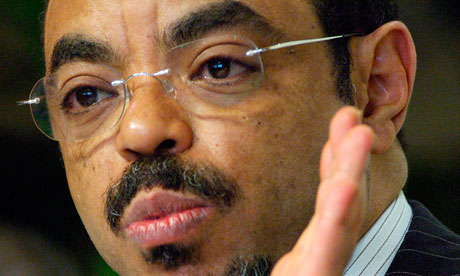
"We are not worried that there will be a north Africa-type revolution in Ethiopia, it's simply not possible”, said the irremovable Prime Minister, Meles Zenawi, on 12 March, with his customary assurance. “The circumstances for it do not exist".
But wait a minute… If Meles thought was not “not possible” that this kind of revolution could spread to his country, why did his actions contradict his words? Why did he suddenly implement a raft of heavy-handed measures, adding censorship to intimidation and repression – in his usual style – as well as State economic intervention and call for patriotism?
Censorship: Ethiopian television – state-run and the only official station – hardly mentioned the Arab uprisings. Meanwhile, the screws have been tightened on the “independent” media, obliging them to censor themselves even further. International radio stations broadcasting in local languages, like Voice of America and Deutsche Welle, were jammed. But it was a wasted effort – this “Spring” triggered an effervescence, leading to the most open and heated debates since the electoral campaign of 2005.
Intimidation and repression: “The government is not blind and deaf”, Meles declared in Parliament on 5 April. Anyone who takes part in what he called “the plot being hatched to incite protests and terror” would “pay a price.” “Intimidation and demonization” retorted one of the leaders of the main opposition party, to whom this warning was specifically addressed, and all the more so, given that the government had already taken measures. Over two hundred militants were arrested in March, more than a hundred of them accused of “terrorism” linked to the Oromo Liberation Front, an illegal movement waging an armed struggle on behalf of the largest ethnic group in Ethiopia. There have been sporadic shows of strength by the security forces as a reminder, if one were needed, of how the regime will react to demonstrations.
But most spectacular has been a return to a form of state interventionism completely at odds with the government’s entire economic strategy. Since the autumn, inflation has started to soar once again, with an official annual rate of 29.5% in April. The government was worried that it would spoil its economic record, currently the very basis of its legitimacy. And, worse still, it was already leading to popular discontent and could even spark off “hunger riots”. The opposition’s forecast could well become a reality: “There are too many economic problems: inflation, unemployment… When they are too much, it may explode”.
Meles Zenawi reacted by pointing the finger at “market disorder”, without any further details, rather than implicating the global rise in prices, the 16% devaluation of the national currency, the Birr, in September 2010, or even the perpetual dogma of a 10% continued annual growth in grain production. To correct this “disorder”, he suddenly announced on 6 January, a price cap on nineteen basic products, including oil, sugar, meat and bread. The economic operators squawked in protest, saying that the imposed prices deprived them of any profit margin. So, several of these products have disappeared from the shelves or have entered the black market at exorbitant prices. In reaction, the government has put them on sale at the official price, but in insufficient quantity, leading to endless queues. The result is that the level of public dissatisfaction mounted a notch. It was easy for the opposition to criticize the incoherence of government policy. On the one hand it pointed out that the massive arrival of private foreign investors is the sine qua non of its economic strategy. And on the other hand, these price caps would be “a step toward a Communist-style command economy”.
And there was patriotism, on the theme of: ‘let’s overcome our political differences and unite for the defence and development of the mother country’. For the defence: against the arch-enemy, Eritrea. For the first time, Ethiopia publicly declared that its goal was to overthrow the regime of Issayas Afeworki by increasing its support for the Eritrean armed opposition. And, in terms of developing the motherland, there is the construction of a gigantic dam on the Nile. Pompously baptised the Millennium Dam or Renaissance Dam, it would be the largest in Africa and the tenth largest in the world. This project suddenly appeared from nowhere, as it is not mentioned in the recently adopted five-year plan. Yet even the most optimistic cost is equivalent to the entire annual budget. As international donors are reluctant to get involved, this cost has to be borne mainly by the country itself. A massive issue of government bonds has been launched. It is restrictive for the banks. All state employees have been “invited” to donate one month’s salary, hence the joke going around: “Not only does the Nile carry off Ethiopian soil, but the salaries of its civil servants as well”. Naturally, it is a euphemism to say they do not appreciate this…
Did Meles Zenawi over-react, as usual, by proving, for the nth time that, in his heart of hearts, he is less confident about the durability of his regime? Does he feel his regime is much more fragile than he proclaims in public or even than most observers assess? In other words, should he be taking these measures at all, even more so when they have largely been counter-productive?
Meles Zenawi knows that his regime shares a fundamental characteristic with those in Tunisia, Egypt, Libya and Yemen that has been fuelling the growing protest – decades-old authoritarianism in a de facto one party state. It even embodies some extreme features that have long disappeared elsewhere. For example, in rural areas– 83% of the population –, everyone aged between 15 and 65 has to devote on average a day a week to so-called “development work”, without having the slightest say either in their purpose or the way they are carried out.
Meles knows that youth spearheaded the Arab uprisings. And two-thirds of Ethiopians are under 30 years old. He also knows that the movement formed independently of the official opposition, and that even its elimination, to which he is tirelessly devoted, is no guarantee that his regime will continue to survive. Strictly speaking, this legal opposition has been crushed after the 2005 elections, when it had risen up totally unexpectedly. The protests stirred up by these elections were very severely repressed, leaving 200 dead and probably as many as 30,000 protestors or suspected opponents rounded up and imprisoned.
Opposition party leaders have disappeared into imprisonment, exile or shut up through psychological pressure. To such an extent that, of the 3.6 million local government councillors “elected” in 2008, only a handful, literally, were members of the opposition. Just a single opposition seat out of the 547 members of Parliament in 2010. One of its leaders went so far as to say that the future of the opposition is now only in the hands of God. For the majority of Ethiopians, legal openings in politics are just as limited as they were in the Arab countries. They are convinced that they are being deprived of their right to turn their aspirations into classical political action.
But Meles Zenawi, whose impressive intellectual ability is recognised by all who meet him, including the greatest world leaders, also knows full well that his regime, Ethiopian culture and history have certain specificities that are slowing, if not blocking, the spread of this wave of protest.
It is generally admitted that aspirations towards democracy increase in proportion to the rate of access to basic education, Internet and mobile telephones. And these rates of access are much lower in Ethiopia than in the Arab countries concerned. Half of Ethiopian children go on to finish primary school, compared to practically 100% of Egyptian children. On top of a very tight control on the contents of electronic means of communication, the rates of comms access are much lower in Ethiopia too. Access to a mobile phone is proportionately thirteen times lower than in Egypt, and access to the Internet forty times lower., Thus it is not surprising that the appeal to demonstrate on 28 May seems to have reached very, very few Ethiopians.
Also, the gulf between the oligarchies, clans or even the autocracy, that ruled Tunisia and Egypt with growing autism, and an increasingly lucid population, had already become obscene ages ago. In Ethiopia, this rift is certainly not as deep, nor could it be, since it only started to form recently, which makes it less often perceived.
At least up until its internal split in 2001, the Tigray People's Liberation Front (TPLF) was probably the only ruling party in the world whose leadership continued to function collectively on a daily basis, just as it had done since it was created in 1975. Since then the personal hold of Meles Zenawi has continued to increase, but it is not all that visible, mainly because of the heavy shroud of secrecy that always surrounds the exercise of power. In particular, the kind of personality cult that accompanied Ben Ali, Gaddafi and Mubarak is unknown in Ethiopia.
The undeniable economic growth, even if it has been outrageously exaggerated by official statistics (which claim “double digit annual growth”), dates from only ten years back. It is inextricably linked to a clear drift towards oligarchy and blatantly growing inequalities. But, and this is where Tunisia or Egypt are fundamentally different: the average Ethiopian is not running into a wall whenever he tries to move on. The beginning of a middle class has emerged in the wake of the political and economical elite, because the economic realm is still relatively open. While, for the majority, the legal route into politics is closed, a fringe of Ethiopians, among the most educated and the most enterprising, continues to get glimpses of a way out, an opportunity that it can still grasp, by jumping onto the economic elevator. In urban areas, this means joining the circle of businessmen or, if that is not possible, the ever swelling ranks of civil servants. In rural areas, for those who can connect to commercial networks, it means joining the new peasant élite.
This category of young people would ordinarily be the spearhead of the protest movement. But the possibility of personal gain is by and large putting them off. And there are other hindrances, too.
One is cultural. At the very beginning of the uprisings in Arab countries, a few ‘ordinary’ individuals took the initiative of standing up to the ruling powers, simply confident they were empowered to exercise their individual rights. Since time immemorial Ethiopian society has been impregnated with an acute sense of hierarchy. This type of spontaneous and solitary ‘grassroots’ behaviour is much less probable there and might even seem to be perceived as misplaced. Everyone has a precise social rank that assigns him or her a precise role. Historically an opposition force has only emerged when one of the figures at the top of the social pyramid sets things going and then takes over as its leader. Social position granting them the legitimacy to do so.
Another factor holding the people back is simply fear. Everyone still remembers the post-2005 repression. No one expects the regime to keep its guns lowered – literally – in the face of the demonstrators. If the Arab uprisings soon broke through this wall of fear, it is probably because they sensed that their own strength would lead the army to distance itself from the ruling power and thus deprive it of its only trump card – repression. But how would the command of the Ethiopian army – monopolized by Tigreans – react in the same circumstances? The answer is almost unanimous – it would defend the regime to the last bullet, because its position as well as the advantages it brings lie entirely on the regime remaining in power.
“Better the devil you know that the angel you don’t know”, as the Abyssinian proverb goes. It is the local version of the almost universal call and response song – stability and order are worth more than the unknown. And all the more so when this angel could turn out to be a devil who is a lot worse than the one already in power.
The Arab protestors were convinced that their aspirations to democracy were sufficiently strong not only overthrow the regimes but also to overcome their own inevitable differences and divergences until democracy was in place. The vast majority of their Ethiopian counterparts say they could not share this conviction either, even though they might deny it, to defend their own interests, or because they sincerely believe that any kind of break would bring immense dangers with it.
In 1991, the new regime chose a paradigm to achieve a harmonious “living together” welcomed by all the “nations, nationalities and peoples” of this country –an “ethnic federalism”. This institutional change logically led to an affirmation of the ethnic identities of Ethiopians. But, instead of easing ethnic tensions, the changes exacerbated them. Although this federalism formally institutes a fair power sharing, authority is, in practice, pyramidal. The Tigreans – about 6% of the population – are outrageously over-represented in all the key political, military, security, administrative and financial positions. To strengthen its base, the regime never stopped letting all Tigreans know that it is the best guarantee of their progress and, soon, their security. There is now a widespread perception that any Tigrean identifies himself completely with the regime.
So, the potential protesters are worried that demonstrations could lead to the worst scenario. It would lose them control of their own movement, which would spark off a civil war, with among others anti-Tigrean pogroms, a breakdown in the army because the troops would rebel against their commanders out of a refusal to repress demonstrators from “their” own ethnic groups, even the break-up of Ethiopia provoked by an insatiable thirst for revenge by the Oromos. Naturally, the ruling power continues to rattle this scarecrow, as it had during the 2005 electoral campaign, when it warned of a Rwandan scale genocide if the opposition were to gain power.
The great majority of these potential protesters say they have made the same choice, either out of conviction or of vested interest – to keep quiet. Some of the more optimistic even say it has some distinct advantages. They hope that, with the passage of time, the enlargement of the middle class might lessen ethnic divisions. But most of them are much more pessimistic. Time would have the opposite effect – of deepening the divisions even further, until the inevitable day the worn-out regime finally fails, making this fall even more brutal and chaotic.
Will this inaction ensure the regime stays in power indefinitely? Both optimists and pessimists put forward an alternative and very different hypothesis. This time it would be the “common people” of Addis-Ababa who enter the arena. What starts as a banal altercation would turn into a popular riot, totally spontaneous and unpredictable. It would spread like a trail of gunpowder, and, by degenerating into ethnic clashes, would sweep everything up in its wake. Under this hypothesis, the life expectancy of the regime would be a matter of days rather than decades.
But prudence – and modesty – are the word. No one had predicted either the eruption or the course of the “Arab Spring”. Ethiopia may still surprise.