Tuesday, September 27, 2011

Ethiopian Christians celebrate the discovery of the True Cross


Tens of Millions of Ethiopian Orthodox church followers on Tuesday evening celebrate the eve of Demera, a festival marking the discovery of the True Cross, a crucifix on which Jesus Christ is believed to have been crucified.
Ethiopia has a population of about 80 million people, and half of those are believed to be Orthodox Christians.

In Addis Ababa, the main centre of the festivities, thousands of people have already made a pilgrimage to Meskel Square, where the celebration will take place on Tuesday evening.

The square is already teeming with tourists, Christians and the diplomatic community, who are all gathered to take part in the commemorations.

Roads leading to Meskel Square, a traditional place for hosting huge crowds, have since been closed as the authorities try to prevent traffic jams and congestion.

The eve of Demera, which means the discovery of the True Cross, is a colourful celebration across Ethiopia.

Each year, the celebrations in Addis Ababa are attended by more than 100 000 people.

The day is marked with a grand bonfire ceremony, which is lit by the Patriarch of the Ethiopian Orthodox Church, Abune Paulos, as he gives religious blessings to the gathering.
Hundreds of priests and deacons, dressed in traditional Ethiopian plain white clothes sing hymns to add colour to the event.
The festival, which dates back 1 600 years ago, is celebrated with yellow Meskel daisies placed on top of huge bonfires that are lit in the evening in front of the throngs of celebrators.
Ornate priests, carrying silver Coptic crosses, dance with their followers around the fires singing and chanting, while carrying flaming torches.
Empress Helena
The festivities, which are capped by the recreation of the cross using Meskel daisies, also mark the end of the three-month long rainy season and the return of summer to Ethiopia.

The Ethiopian calendar has 13 months. The thirteenth month, known, as Pagume, like a leap year, has 5 or six days depending on the season.

The celebration of Meskel signifies the presence of the True Cross at the mountain of Gishen Mariam Monastery in Ethiopia and also symbolises the events carried out by Empress Helena.

According to tradition, smoke drifted towards the direction of the buried cross when Empress Helena lit incense and prayed for assistance and guidance.

She dug and found three crosses; one of them was the True Cross on which Jesus Christ is believed to have been crucified.

The empress then gave a piece of the True Cross to all churches, including the Ethiopian Orthodox Church. Parts of the cross were said to be in Israel.

This piece has since been brought to Ethiopia.

According to Ethiopian legend, when people got close to a piece of the True Cross it made them naked because of its powerful light.

For this reason, a decision was made to bury it at the Gishen Mariam Monastery in Wollo region.

The monastery is home to a voluminous book, which records the story of the True Cross of Christ and how it was acquired. The place is one of Ethiopia’s main tourist attractions.

Press freedom in Ethiopia A tightening noose


Sep 27th 2011, 6:42 by J.L. | NAIROBI

BAOBAB recently penned a piece on the decline of the importance given to human rights. It ended with a call for greater resolve: "when anybody feels strongly enough about a cause to make a sacrifice, that compels a certain respect. Lofty, cost-free moral lectures count for less and less."
This is particularly true of press freedom in Africa. According to the African Federation of Journalists, many African countries have accelerated their abuse and imprisonment of journalists. Eastern Africa is the worst affected, with the assassination of journalists in Somalia and the disappearance and torture of journalists in Eritrea. Indeed, in the Eritrean case the mistreatment is evidence of the brutality and paranoia of the regime.
Neighbouring Ethiopia is not so bad; it welcomes visitors, including the World Economic Forum, and the government has improved food security and services to the poor. But in its treatment of reporters, Ethiopia is sliding towards Eritrea.
Take the case of Eskinder Nega, an Ethiopian journalist who has been imprisoned on anti-terrorism charges for his criticism of the government following the Arab uprisings. Mr Nega and his wife, Serkalim Fasil, were jailed for 17 months for their reporting following Ethiopia's disputed 2005 elections, in which the government arrested thousands of students and opposition supporters and was responsible for at least some of the post-election violence. The Negas' newspapers were among dozens later closed by the government.
An open letter by international journalists to the Ethiopian foreign minister highlights broader abuses: "Ethiopia's history of harassing, exiling and detaining both domestic and foreign reporters has been well-documented. Ethiopia is the second-leading jailer of journalists in Africa, according to the Committee to Protect Journalists. Over the past decade, 79 Ethiopian reporters have fled into exile, the most of any country in the world, according to CPJ data. A number of these have worked as stringers for international news agencies. Additionally, since 2006, the Ethiopian government has detained or expelled foreign correspondents from the Associated Press, the New York Times, the Daily Telegraph, Bloomberg News, the Christian Science Monitor, the Voice of America, and the Washington Post. We are also concerned by the government's recent decision to charge two Swedish journalists reporting in the Ogaden with terrorism."

Sunday, September 25, 2011

Patrick Makau breaks Haile Gebrselassie's marathon world record in Berlin


Kenya's Patrick Makau
Makau sets marathon record in Berlin
Patrick Makau retained the Berlin men's marathon title in a world record time.
The Kenyan finished in a time of two hours, three minutes and 38 seconds to shave 21 seconds off the record set by Haile Gebrselassie on the same course.
The Ethiopian great failed to finish having experienced apparent stomach problems around the 27km mark.
"In the morning my body was not good but, after I started the race, it started reacting very well. I started thinking about the record," said Makau.

GEBRSELASSIE'S RECORD AT BERLIN MARATHON

  • 2006 - First in 2:05.56 (fastest time of year)
  • 2007 - First in 2:04.26 (world record)
  • 2008 - First in 2:03.59 (world record)
  • 2009 - First in 2:06.08
  • 2010 - Did not compete
"I didn't have any problems in the race. Last year I had some problems with my soles inside my shoe, but today everything went very well."
Gebrselassie, the 38-year-old double Olympic champion at 10,000m, had also been looking to post a fast time and ease the pressure on him to qualify for the Games ahead of strong Ethiopian rivals.
But he found himself forced to step off the road midway through the race as Makau, sensing the Ethiopian great was struggling, upped the pace.
Gebrselassie set the previous world record time with a mark of 2:03.59 in the third of his four consecutive Berlin victories between 2006 and 2009.
However, this year he halted for a full minute as his hopes of a quick time evaporated, then pulled out for good at the 35km mark.
"He was still feeling good at 25km but then his lungs started tightening up. He could not breathe - we don't know why," his agent Jos Hermens said.
Hermens added that Gebrselassie suffers from asthma and is allowed to take medicine, but had not taken any because he had not had any problems for months.
"Maybe this was a mistake, but he felt fine before, his preparation was good," he said.
"Qualifying [for London 2012] may be a problem now, we don't really know where to get it."
Gebrselassie is now expected to head to Dubai in a bid to ensure he reaches the London Olympics.

Saturday, September 24, 2011

HIM Hailesellasie's words on religious equality

By T, Staffer of De Birhan Media 
25-9-2011
The indefatigable name tarnishing attempts of some religious fanatics about HIM Hailesellasie is infuriating. Especially, some Ethiopian religious chat rooms and discussion forum  have been labelling HIM as an anti to some religious denominations.
Let me quote a verse from  Theodore M. Vestal,2011 book entitled An introdcution to the Lion of Judah in the New World that  precsisly tells on how misinformed and manipulated we were of our own treasures.
"In the present-day Ethiopia, few know just how popular their monarch was in the New World.It is perhaps difficult to understand how a ruler so reviled in his homeland for more than 35 years by successor governements could have been such an international celebrity and be so royally recieved abroad.Haile Sellassie was a major actor on the world stage, and because of that , Ethiopia enjoyed prestige and respect throughout the world that has been absent in later years (Theodore M. Vestal,2011). "

To emphasise my premises here is a speech HIM Hailesilassie gave on October 11, 1963 during his visit of the mosque in Asmara, Eritrea following the welcoming speech by the head of the mosque Sheikh Ibrahim Oumar Muktar.
It is taken from the 2nd volume of “firekenafir Ze Kedamawi Hailesilassie Niguse Negest ZeEthiopia.” (Witty Words of Mouth from Hailesilassie I King of Kings of Ethiopia.) The speech balances these baseless allegations and divisive hearsays. 

Click on it to enlarge and read :

Friday, September 23, 2011

Crackdown in Ethiopia continues

By T, Staffer of De Birhan Media 
23-9-2011
Continuing its crackdown, the Meles regime arrested five more members of the opposition All Ethiopian Democratic Party (AEDP) which called for peaceful demonstration on Oct 2 in Addis Abeba, Meskel Square. Reports from Addis Abeba reveal that in fear of the arrest of more members many are fleeing while the rest being locked up.
It is to be recalled that two parties based in Ethiopia : All Ethiopian Democratic Party (AEDP) and Ethiopian Unity Democratic Organisation (EUDO) had called for a large scale peaceful demonstration in Addis Abeba for the 2nd of October 2011 in the same place. There are also reports that the date of the demonstration has been postponed to November.

Mungiki leaders who led revenge attacks all killed

Posted by LORDRICK MAYABI on September 23, 2011
Capital FM


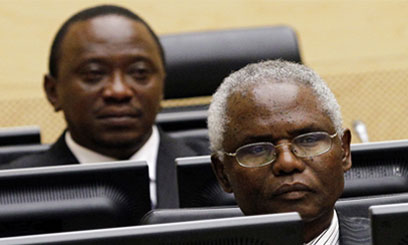
Uhuru Kenyatta and Francis Muthaura at the ICC/FILE
NAIROBI, Kenya, Sept 23 – The International Criminal Court has been told that Mungiki leaders who led retaliatory attacks in Nakuru and Naivasha have all been eliminated by the dreaded Kwekwe police squad, to prevent them from implicating the organisers.
The sensational claims were made by counsel Desiree Lurf during submissions highlighting the criminal responsibility of former Police Commissioner Mohammed Hussein Ali in the post-election violence.
Lurf said that Ali ordered the elimination of Mungiki members who could have implicated Deputy Prime Minister Uhuru Kenyatta and Head of Public Service Francis Muthaura in the revenge attacks of 2008.
“Extra judicial killings of high ranking Mungiki members including the wife of the Mungiki leader (April 13 2008) and other two senior members on 28 April (2008) who were the link between (Maina) Njenga and the PNU leadership show that there was an effort by the Kwekwe squad to eliminate high level Mungiki members who knew about the crimes and could testify.  Ali ordered the eliminations,” she said.
Lurf further told the court that the report of the UN Special Rapporteur Philip Alston on extra judicial killings in 2009, which recommended of the removal of Ali from the police force, also showed the continued existence of a police squad whose main aim was to eliminate the Mungiki and other suspected top profile criminals at the order of senior police officers.
Ali was also accused of frustrating police investigations into the post-poll chaos in a bid to ensure the main perpetrators evaded justice.
The court also heard that the weapons used by the outlawed Mungiki sect to retaliate in Nakuru and Naivasha were shipped form war torn neighbouring Somalia and transported to State House, Nakuru.
During the third day of confirmation of charges hearing in the case of the prosecutor against Deputy Prime Minister Uhuru Kenyatta, Head of civil service Francis Muthaura and former Police Commissioner Hussein Ali, the prosecution said the Mungiki received the weapons in January 2008 after violence had broken out.
Prosecutor Adeboye Akingbolahan said: “In preparation, the Mungiki purchased weapons from Somalia in January 2008.  According to prosecution witness nine, the weapons included guns and machetes.”
The prosecution said that Muthaura and Ali – who had prior knowledge of attacks against ODM supporters – ordered the unhindered movement of Mungiki into the Rift Valley and despite intelligence reports, Ali ensured that police had inadequate resources to combat thw Mungiki in Naivasha while Uhuru was in charge of the finances.
“Most of the money came from Kenyatta. Muthaura instructed police to create a free zone. On a query if police would interfere with the Mungiki’s movement, Muthaura said “the police will not interfere with your work.” He called Ali and ordered that Mungiki should not be disturbed,” Akingbolahan said.
On the third week of January 2008, Central province MPs mobilised pro-PNU youths at rallies.  The lawmakers told the youths “to do something” about the attacks on their kinsmen. Volunteers then registered with the Mungiki, were paid and transported to attack locations.
According to the prosecution: witness 12 “The ones in Thika were paid to enter the lorry and were given Sh150, 000 to share among themselves.”
The prosecution affirmed that the suspects gave more money to Mungiki leaders to ensure their continued participation in the common plan.
“Sh20 million was given to a Mungiki leader by a PNU liaison two, to a direct subordinate of Muthaura and Kenyatta. Witness 11 said the liaison was answerable to either the two suspects depending on the nature of the issue in question,” he added.
The first liaison of the PNU is said to have given police uniforms to the Mungiki and was also responsible for distributing weapons.
Kenyatta is said to have placed the Mungiki under the authority of a former KANU MP, who coordinated the revenge attacks in Nakuru and Naivasha.
According to the prosecution, with the execution of the crimes of forcible transfer, rape, forcible circumcision and destruction of property, the perpetrators severely deprived the victims of fundamental rights against international law.
The court heard that the Mungiki inflicted injuries to the mental and physical health of the victims, forcibly circumcised the men, destroyed homes and used terror tactics.  Accounts of   prosecution witnesses reported that victims of attacks were identified by local informers and use of prepared lists.
The Mungiki and pro-PNU youths are also said to have set up roadblocks in and out of Nakuru to filter non-Kikuyus while persons from the Luo and Luhya communities travelling in public transport vehicles were singled out as the main targets.
Judges at war crimes court were also told that the government received intelligence reports in time to prevent retaliatory killings of ODM supporters after the disputed 2007 general election.
Lurf said that the National Security Intelligence Service (NSIS) had provided information on possible attacks in advance but that Muthaura and Ali deliberately failed to act.
Muthaura was the first among the suspects to mount a defence after the prosecution ends its submissions on Friday evening.Capital FM

Djibouti, at UN, appeals for proactive aid to prevent drought and faminetle


President Ismaël Omar Guelleh of Djibouti

23 September 2011 – 
Djibouti, one of the countries most severely affected by the current drought and famine in the Horn of Africa, today used the podium of the General Assembly to call on the world to not only provide immediate aid but also take the longer-term steps to prevent a recurrence.
“Our immediate needs are urgent and we are grateful to the friendly countries and international organizations who have participated in our efforts,” Djibouti’s President Ismaël Omar Guelleh said of the drought and famine that have severely afflicted at least 13.3 million people in Djibouti, Ethiopia, Kenya, and most particularly in Somalia, where tens of thousands of people have already died and more than 3.2 million others are on the brink of starvation.
“However, taking into account the endemic nature of drought in our region we must go beyond a reactive attitude and our efforts must from now on be focused on long-term prevention,” he added, noting that Djibouti has several projects under way, including water storage during flood times on the Awash River and the use of arable land.
“Faced with this terrible scourge, the region’s resilience is sorely tried and emergency measures cannot alone respond to the challenges we currently face.”
Turning to the political situation in Djibouti’s southern neighbour, Somalia, Mr. Guelleh cited recent improvements in the war-torn country following the withdrawal of Al-Shabaab Islamic militants from Mogadishu, the capital, and agreements by the transitional authorities to set up a functioning central government by next August in a country that has had none for the past two decades, during which it has been torn apart by factional conflicts.
He appealed to the international community to provide the transitional authorities with the necessary resources to reinforce its fragile capacities.
Turning to Djibouti’s northern neighbour, Eritrea, with which it fought in a border dispute in 2008, Mr. Guelleh said he had still not received any word about 19 Djiboutian prisoners of war despite Security Council resolutions and the efforts of regional organizations, but he committed himself to mediation as the sole path to a lasting peace.

Sudan 'set for major attack' in Blue Nile


KHARTOUM — Fresh satellite images appear to show the Sudanese army preparing to launch a major assault on the rebel-held border town of Kurmuk in the embattled state of Blue Nile, US monitors said on Friday.
The claims coincide with a statement by rebel group the SPLM-North that the army has carried out air strikes on Kurmuk, targeting the offices of humanitarian organisations including Save the Children.
The satellite pictures, taken on September 21, reveal a mechanised unit of Sudan's military comprising at least a brigade -- 3,000 troops or more -- within 64 kilometres (40 miles) of Kurmuk, the Satellite Sentinel Project (SSP) said in a statement.
"These forces appear to be equipped with heavy armour and artillery, supported by helicopter gunships, and pointed south along the main road from the capital of Damazin," said the group, which was set up by Hollywood star and rights activist George Clooney.
"This irrefutable, visual evidence of massive military operations in Blue Nile State provides a human security warning to civilians in Kurmuk and the surrounding area," it added.
The group accused the Khartoum government of using indiscriminate force since May, including targeted air strikes on civilians, in the three border areas of Abyei, South Kordofan and Blue Nile state.
The army spokesman was not immediately available for comment.
Fighting has raged in South Kordofan between the Sudanese army and militiamen loyal to the SPLM-North, Sudan's main opposition party, since early June.
Dozens of people were reported killed, including an NGO worker, in heavy fighting on Thursday.
The conflict, apparently triggered by the army's insistence on disarming SPLM-North elements, spilled into nearby Blue Nile state this month, as the government moved to assert its authority within its new borders following South Sudan's formal secession in July.
The forces of the SPLM-North's leader Malik Agar, Blue Nile's elected governor until he was sacked by President Omar al-Bashir when the fighting erupted, were driven out of the state capital Damazin.
But they have held firm in their former civil war stronghold of Kurmuk, on the Ethiopian border.
SPLM-North spokesman Arnu Ngutulu Lodi said in a statement on Friday that an Antonov aircraft bombed the town, targeting the UN headquarters and office of Save the Children.
He gave no details of casualties and the claim could not be independently verified.
Earlier, the World Food Programme urged Khartoum to allow the UN agency full access to Sudan's two embattled border states, saying that at least 235,000 people in both areas needed assistance.

Thursday, September 22, 2011

Freedom House Policy Brief: Growing Challenges to Internet Freedom

by Daniel Calingaert, Deputy Director of Programs 

Next week, government, business, and civil society representatives will gather at the Internet Governance Forum (IGF) in Nairobi, Kenya to discuss the future of the global digital space.  This gathering takes place against the backdrop of growing restrictions by repressive regimes on online freedoms.  The U.S. and European governments have undertaken significant initiatives to respond to these restrictions, but their initiatives are inadequate to stem, let alone reverse, the decline of freedom on the internet.  Stronger action is needed.


Restrictions on the Internet

Even before the Arab Spring had shown the power of the internet to accelerate the free flow of news and views and to bring like-minded citizens together to mobilize for change, authoritarian regimes had introduced extensive controls over digital media.  Authoritarian regimes had built pervasive, multilayered systems for online censorship and surveillance.  These systems have grown more diverse and sophisticated in the past two years, as documented in Freedom House’s 2011 Freedom on the Net report and elsewhere.
Governments increasingly resort to “just-in-time” blocking of online content or social media applications at critical moments, such as periods of unrest.  Malawi’s government, for example, blocked access to news websites, Facebook, and Twitter in July as part of its clampdown on mass protests.  Just-in-time blocking at times has affected a whole country’s internet.  Access to the internet was cut off entirely in Egypt amidst the January 2011 mass protests calling on then President Hosni Mubarak to step down and in Libya in March 2011 as its leader, Muammar Qaddafi, tried to stem the anti-regime uprising.  Moreover, government control of internet infrastructure is increasingly being used to insulate citizens from the global internet.  Iran, for instance, is taking steps toward the creation of a national internet to disconnect Iranian users from the rest of the world.

Intermediary liability is on the rise as a method of censorship.  Governments increasingly hold hosting companies and service providers liable for the online activities of internet users.  In Vietnam and Venezuela, some webmasters and bloggers have disabled the comment feature on their sites to avoid potential liability.  Governments also force businesses to police internet use.  Belarus, for example, introduced requirements for Internet cafés to check the identity of users and keep a record of their web searches.
Online surveillance appears to have grown more extensive over the past two years.  In Iran, for example, the government used intercepted online communications, including activities on Facebook and the Persian-language social media site Balatarin, to prosecute activists involved in protests against the fraudulent 2009 presidential election.  Many arrested activists reported that interrogators confronted them with copies of their emails, demanded the passwords to their Facebook accounts, and questioned them about individuals on their friends list.

Digital attacks against human rights and democracy activists have become widespread.  The pro-regime Syrian Electronic Army defaced Syrian opposition websites and spammed popular Facebook pages, including that of U.S. President Barack Obama, with pro-regime messages.  Sophisticated cyber attacks have also originated from China.  These included denial-of-service attacks on domestic and overseas human rights groups, email messages to foreign journalists containing malicious software capable of monitoring the recipient’s computer, and a cyber-espionage network, which extended to 103 countries, to spy on the Tibetan government-in-exile.  In Belarus, to stifle protests against the fraudulent December 2010 elections, denial-of-service attacks slowed down connections to opposition websites or rendered them inaccessible.  Moreover, the country’s largest internet service provider, the state-owned Belpak, redirected users from independent media sites to nearly identical clones that provided misleading information, such as the incorrect location of a planned opposition rally.  Digital attacks on websites or blogs that are critical of the government have also taken place in several countries rated “partly free” on internet freedom by Freedom House, including Kazakhstan, Malaysia, and Russia.
International Support for Online Freedom

The U.S. and European governments have developed similar policies to promote internet freedom.  These policies generally pursue the following aims: 

  •  Preserve open nature of internet The U.S. and European governments have resisted attempts to place Internet governance under the United Nations, specifically the International Telecommunication Union, where authoritarian regimes may have greater scope to control online space.  They instead support the multi-stakeholder bodies that currently govern the Internet, such as the Internet Corporation for Assigned Names and Numbers (ICANN).
  • Expand international recognition for key principles of free expression online A wide range of democratic governments have agreed on the principle, as expressed by Swedish Foreign Minister Carl Bildt, that “The same rights that people have offline—freedom of expression, including the freedom to seek information, freedom of assembly and association, amongst others—must also be protected online.”  This principle was reaffirmed and elaborated by United Nations Special Rapporteur for Freedom of Expression, Frank La Rue, in his report on Internet freedom to the UN Human Rights Council in June 2011.
  • Support digital activists The Netherlands and Sweden have begun to fund programs to support bloggers and cyber dissidents who come under threat.  They have also pushed for greater European Union funding for internet freedom programs.  The U.S. State Department has supported a range of initiatives to promote digital activism and spoken out against the arrests of prominent bloggers, such as Bahraini “blogfather” Mahmood al-Yousif. 

  • Fund anti-censorship technologies and digital security The U.S. State Department has spent $50 million since 2008 on a range of Internet freedom programs and is about to receive $20 million more.  These programs have included support for technologies to circumvent online censorship, secure mobile phone tools, efforts to reintroduce blocked content to users behind a firewall, and training for activists in digital security.  (Freedom House’s internet freedom programs are funded in part by the U.S. State Department.)


Recommendations to Strengthen Internet Freedom

The growing restrictions imposed by repressive regimes are outpacing U.S. and European efforts to protect the space for free expression online.  To expand that space, U.S. and European governments should build on their current policies with additional initiatives:

  • Challenge restrictive internet laws and practicesThe U.S. and European governments should pursue joint, targeted initiatives to press for the removal of existing restrictions and to avert new restrictions that are under consideration.  They should also develop an action plan to implement the recommendations of Mr. La Rue’s report, particularly to curb restrictions on internet content, criminal penalties for legitimate online expression, intermediary liability, infringements on online privacy, and cyber attacks.  This action plan should be developed and implemented in collaboration with other democratic governments.

  • Address internet censorship as a barrier to free trade The U.S. Trade Representative and the European Union have shied away from trade disputes over internet censorship.  Although there are strong economic interests in avoiding such disputes, the United States and the European Union should challenge specific censorship practices under bilateral trade agreements with China and other countries and present a case against internet censorship before the World Trade Organization, because the potential loss of trade will provide a strong incentive for China and other countries to cut back on their censorship of online content and service


  • Require transparency in sales and services to internet-restricting countries:  American and European companies that come under pressure from authoritarian regimes to facilitate violations of human rights, for instance to filter online content or to provide access to private user data or communications, cannot be expected to stand up to such pressure on their own.  They should be required to publicly disclose what products and services they provide to countries with extensive internet restrictions and what requests they receive from these countries to filter web content, turn over private data, or facilitate communications intercepts.  Such disclosure would discourage technology companies from collaborating with internet censorship and surveillance and encourage U.S. and European governments to push back on such collaboration.
  • Introduce export controls on censorship and surveillance technologyVoluntary measures are clearly inadequate to prevent the use of U.S. and European technology to violate human rights.  Carefully crafted export controls are needed.  These export controls should target specific technologies, such as content filters and spyware, that serve the primary purpose of limiting flows of online information or monitoring private digital communications.  Dutch Foreign Minister Uri Rosenthal has called for export controls on filtering technologies, and the European Parliament voted in April 2011 to introduce export controls on technologies for monitoring mobile phone and internet use, but these export controls still require the European Council’s approval.

    To advance internet freedom in the face of growing restrictions around the world, the U.S. and European governments cannot rely entirely on uncontroversial measures, such as advocating broad principles, criticizing flagrant abuses, and funding programs.  They need to take bolder actions that directly challenge vested interests at home and abroad.  Such actions are vital to reverse the global trend toward greater suppression on internet freedom.

Peter Goodspeed: Left to die in Africa’s North Korea

Aaron Lynett/National Post

Aaron Berhane, who escaped arrest and imprisonment in Eritrea in 2001, now edits and publishes an Eritrean newspaper in Toronto.


 Sep 22, 2011 – 6:15 AM ET Last Updated: Sep 21, 2011 10:55 PM ET
Goodspeed Analysis
In the agony and anguish that followed the 9/11 terror attacks, the world lost sight of the horror and fear that have seized tiny Eritrea, Africa’s version of North Korea.
For more than 50 years, the strip of rock and sand wedged between Ethiopia and Sudan along the south coast of the Red Sea has known nothing but insecurity and war, despotism and despair.
It was 10 years ago on Friday the country was finally stripped of hope.
Then, President Isaias Afewerki, Eritrea’s first and only leader since it won independence from Ethiopia in 1991, arrested his leading critics and destroyed the country’s independent press.
On Sept. 23, 2001, he ordered the detention of 11 top government officials who had written open letters criticizing his rule.
He also arrested 10 leading journalists who published the letters and banned all eight of Eritrea’s independent newspapers.
Those arrested were accused of “defeatism” and “divisiveness,” and denounced for trying to bring Mr. Afewerki down during a border war with Ethiopia.
The 20 men and one woman have never been seen or heard from since.
They were never charged with a crime, never appeared in court and have had no contact with their family, friends or lawyers.
“It’s very hard. They are just being kept there to die and they are dying day after day,” said Aaron Berhane, an Eritrean newspaper publisher and editor, who was on Mr. Afewerki’s original hit list, but escaped and now lives as a refugee in Toronto.
“It has been going on for 10 years and no one seems to take notice. The situation is very, very discouraging. They don’t get adequate medical attention; they are not fed well and they are being held in horrible circumstances.”
Reports from former prison guards, who fled Eritrea, say the imprisoned journalists and opposition figures have been held in a secret prison, Eiraeiro, 15 kilometres north of the capital Asmara.
They say 10 of the 21 detainees have died. The remaining 11 are regularly tortured and held in solitary confinement, sometimes in steel shipping containers that are exposed to broiling temperatures during the day and freeze at night.
The surviving prisoners are said to be emaciated and physically and mentally incapacitated.
Two of the journalists arrested were Mr. Berhane’s business partners, co-founders and contributors to their twice-weekly newspaper, Setit, then Eritrea’s largest newspaper with a circulation of about 14,000.
Fessehaye “Joshua” Yohannes, a poet and playwright who also worked as a director of a children’s group, Circus Eritrea, is believed to be dead, though there are conflicting, unconfirmed, reports he committed suicide or died from neglect after being manacled and tortured.
Dawit Isaak, another co-owner of Setit, is the best known of the detained journalists, because in addition to being an accomplished novelist and playwright, he has Eritrean and Swedish citizenship. His family fled Eritrea during the war of independence and settled in Gothenberg, Sweden, in the late 1980s.
After Eritrea won its independence, Mr. Isaak returned home, looking for a way to contribute to his homeland.
“He is a humble man with a good heart,” said Mr. Berhane, who is now publisher and editor of the monthly newspaper Meftih for Eritreans in Canada.
“When my partners and I were looking to expand our business and looking for talented writers to join us, Dawit’s name came up immediately. We had asked others, but they were afraid. Dawit never hesitated. He really wanted to do something for his country.”
Since his arrest, Mr. Isaak has been declared a prisoner of conscience by Amnesty International and been nominated for the European Parliament’s Sakharov Prize for Freedom of Thought.
Along with the other eight remaining Eritrean journalists, Mr. Isaak has been “adopted” by PEN Canada and will be honoured Friday in a special remembrance ceremony at Ryerson University in Toronto.
“Everyone has tried to get them out,” said Brendan de Caires, PEN Canada’s program co-ordinator.
“The African Union has tried. The European Union has tried. Swedish diplomats have been trying for the best part of a decade. And they just run up against a president who will say ‘No.’ He just isn’t interested.”
Related Posts Plugin for WordPress, Blogger...