Thursday, April 21, 2011

Meles Zenawi’s belligerence against Egypt Vs Egyptian's investment in electricity

*Egyptian Company receives over two million square metres of land in Mojo to invest in electric cables

21-4-2011

By Anko Zuta,De Birhan Blogspot Staffer

The politics of Dam/ hydraulic is very interesting .One of my relatives is one of the few Ethiopia/African scientists (bragging hahahah). On a serious note, I advise those of you who have yet to do your dissertations, thesis and papers to do it on this subject, especially the Nile River as a case.

Amidst the continuous propaganda and campaign on the damming of the Abay River , a low key but a strategically thought of belligerence against Egypt is being struck by the Meles' regime security and propagandists . One of them is that the damming of the Abay River is a matter of national interest and security and that we all MUST be wary and protectors and defenders of any threat that comes from the Egyptians against our sovereignty. These 'servants' of the regime spread the rumour of military attack from the Egyptians against Ethiopia. In spite of all these Machiavellian rhetoric and ‘patriotic’ preparations, the Meles’ regime has been accepting and legalizing Egyptian public and semi-public corporations and companies to make large scale and strategic investment in different regions of Ethiopia. Elsewedy Cables Ethiopia PLC.: This Company, which works in a closer partnership with the Ethiopian Electric Power Corporation (the Corporation that builds the Grand Ethiopian Renaissance Dam on the Blue Nile), has been granted two million square meters of land to build a grand electrical cables industry zone in the Wonji town of the Oromia Region, Ethiopia last month. Amazingly enough, the Company has committed itself to make an ambitious investment of $ 50,000,000 in Ethiopia, “Due to the huge demand of cables and energy sectors in Ethiopia and the surrounding markets, Elsewedy Cables Holding Co. has taken the strategic decision to invest $ 50,000,000 USD inElsewedy Cables Ethiopia PLC, the first cables manufacturing plant”. The Company’s statement read.


El Sewedy Cables Ethiopia Plc, is an affiliate of the international company, Elsewedy Group, and produces Low Voltage Cables, Medium Voltage Cables, High Voltage Cables,Overhead Conductors, Special Cables, Fiber Optic Cables, Copper telecom cables, Telecom Accessories and Winding Wires. Likewise, many Egyptian companies most owned by the Egyptian government and private entrepreneurs are leasing land to invest in hotels, construction, manufacturing and etc.

What makes most of the investments sarcastically ironic is that they are mostly partnership investments contracted with EEPCo and the government that accuses them of ‘negative energies ’ and conspiratorially intended purposes that extends up to barring the Government from accessing international funding. This ongoing investment also makes it clear that the government has never had the building of the Dam within any of its plans. Since the incumbent came to power, it had built around five mega dams although none of them have so far been quenching the local electricity thrust or were exported. In the middle of these mega dams, Addis Abeban’s still find it hard to have power without termination.


Tuesday, April 19, 2011

Saturday, April 16, 2011

Interview

With a TPLF/EPRDF insider in the Diaspora

The drums of war against Eritrea and perhaps Egypt are being beaten by the Ethiopian People’s Revolutionary Party (EPRDF).The political clout and motion is rapidly changing within the government and the country. While a growing number of Ethiopian youth are in preparation of staging an ‘Arab’like revolution in Ethiopia under the motto of ‘Beka’ (Enough),the Meles’ ‘sultanate’ is also tactically rerouting the Movement into other issues of border war with Eritrea, Damming of the Abay River, and Growth and Transformation Plan. Two weeks ago, I had an online conversation with one of my informers from the TPLF/EPRDF party, whom I recurrently draw on either to balance a tip that I have got or to seek fresh information. For the safety of my interviewee, I prefer to nickname him as Ato EPRDF hereafter. I have never published any of the interviews I had done with my sources from the ruling party, however, I decided to post it this time, presumptuous that it would proofer a little insight about the positions of the ruling party to my critical readers. The source is well informed, up-to-date, 'key' and insider of the TPLF/EPRDF. Following is the unflattering opinion he shared with this Blogger (Anko Zuta) on various issues of political interest.

17-04-2011

De Birhan: I wanted to know what you make of the strategic shift towards Eritrea and the overall political situation in Ethiopia.

Ato EPRDF: I think the political situation in Ethiopia is alright. I think the change in strategy is good, but I don’t know how they are going to do it.

De Birhan : It appears as if the main rhetoric was first diplomacy, finally War.

Ato EPRDF: I know our government is arming and supporting Eritrean opposition groups, they have been doing that for a while, but it hasn't brought any significant change.

De Birhan: some say it is just "displacing the attention of the population to the outside world''.

Ato EPRDF: That could be it.Ethiopia could be denounced if it took direct action against Eritrea by the international community and our funders. So I am doubtful.

De Birhan: Well the Foreign Minister has made the diplomatic readiness to avert that by lobbying the United Nations. Didn’t he? While there is no premises to go out on a limb.

Ato EPRDF: I think the Ethiopian government has credible evidence to support its accusation against Eritrea, they attempted even to disrupt the AU meeting in Addis Ababa. And nowadays it’s difficult to trust the UN and the Security Council; we don’t know how the big nations may act/respond if we go to attack them.

De Birhan: Well strategicwise we are less useful so don't worry. But isn't UN's 2009 embargo on Eritrea being implemented?

Ato EPRDF: We are important strategically and diplomatically man.No war no peace policy,we have now will do its trick in years to come and is a better scenario, that’s better than war. UN'S Ruling is not implemented.Eritrea showed some positive move; they pulled their troops from Djibouti...the EPRDF lost a golden opportunity to oust Shaebiya in 1998...now it’s too late too good. The Ethiopian government shouldn’t even have transferred the border issue to a foreign commission...We should have had crushed Shaebiya. Control the land and ignore Shaebiya for good till it attempts to retake it.That should have been our move.

DE Birhan: So war now?

Ato EPRDF : I don’t think so...Ethiopia is in difficult situation, the country is trying to strike a good balance between local demands and international expectations, imagine our government receives billions of dollars in form of aid and loan, if we start a war it can all stop, and we can go back to square one.

De Birhan : do you fear an uprising in Ethiopia?

Ato EPRDF: no not at all...I expect Dr. Negede or the other leaders of the opposition to go to Meskel square and set themselves on fire to trigger a carbon copy of jasmine revolution,,,

De Birhan : hahaha Would they? Doubtful I am.

Ato EPRDF: you know we have nine regions now, so it’s impossible to see drastic change in Ethiopia through the Jasmine style of revolution. In Tunisia people sacrificed their lives and brought down the government, in Ethiopia the opposition groups don’t want to pay a price for change...they expect the youth to go and die.

De Birhan : well I get communication that there are similar types of self organised youth in Ethiopia too.

Ato EPRDF: In Addis people can organise a rally against the City Administration or against their representatives in the parliament...There will be no Bengazzi and Tripoli in Ethiopia. I don’t think such thing will happen in Ethiopia, we are not new to civil wars as you know there are potential predators that can hijack the situation, we have Islamist extremists, OLF,ONLF and all sort of armed rebellion groups. A rebellion starts in the brain...there are some people in Addis who wish for a revolution, if they really want to pay sacrifice and bring a change...they can do it....100% who ever manages to mobilise the public will succeed but I feel they won’t pay the sacrifice.

De Birhan: Do you think the Government will act ruthlessly? Shoot them?

Ato EPRDF: No. Due to the above reasons I explained.

De Birhan : And the army?

In Egypt, Tunisia the army took over...what’s going to happen in Ethiopia....will the army agree to remove Meles from power, will they agree to remove the EPRDF from power....? What’s the structure and background of our armed forces and how are they viewed by the people....?

De Birhan : Would the army stand with Meles forever?

Ato EPRDF : as we have a federal government, if the public in Addis Ababa wanted a change then the City Administration can be disbanded...and another election could be held. But I don’t expect rebellion in certain regions of Ethiopia. Some will definitely show support, not everyone is dissatisfied with the government. In the presence of article 39 any violent path could lead to the fragmentation and blood shade of the country. I hope true democracy and tolerance are the only choices we have to stay under one Ethiopia...in Libya; the war now is partly tribal. Without our army, security forces etc...the opposition groups can’t do a thing, and their main enemy is Ethiopian army...for them Ethiopian army is Weyane army which ousted the Dergue.

De Birhan: The ‘democraticness’ and tolerance is at your hand, I hope Ambesayee. But from where will change come from?

Ato EPRDF : only the OLF, IFLO, ONLF,EPPF etc...can bring real change provided they manage to destroy the current army, but those groups seem to be incapable and divided....otherwise change if it happens will be from within and it won’t be drastic...it will be symbolic...

De Birhan : Thank you!

Ato EPRDF : Ok w.c.

Friday, April 15, 2011

The Name of the Grand Millennium Dam changed

The Ministerial Cabinet meets

Ethiopian Grand Millennium Dam on the Nile

The renamed Grand Ethiopian Renaissance Millennium Dam on the Blue Nile

By Anko Zuta,Blogger of De Birhan Blogspot

15-04-2011

I remember discussing with one of my friends after a history class (I loved history and always scored 99 or 100), when I was in high school in Addis about the Abay River . During those years, Ethiopia and Eretria were in high time of border war. He asked me, "would you go to war if Egypt was to invade us for the sake of the Abay River?" I replied “ABLSOLUTELY” with high valour and fervour, same was his reply. We were just teens then, and I still can sense it after over a decade how ‘ticklish’ the matter was and will always be. The political dough that was almost to explode into protest and revolutionary u-turn in today's Ethiopia is seemingly being quelled by the very systematic and strategic politico-developmental ‘propaganda’ centred around the renamed The Grand Ethiopian Renaissance Millennium Dam Project on the Nile Dam of the Meles 'sultanate'.Meles' 'sultanate' has been capable enough to mysteriously divert the full focus and attention of Ethiopians at home and in the Diaspora into the the Damming of our River,Abay. The Ministers Cabinet that met today in Addis Abeba sent out this press release , “to keep the heat of people’s emotion and attention on the construction of the Dam, a National Council has been established today April 15,2011 to undertake the PR and other works of the Project'' . The Project has been also renamed 'The Grand Ethiopian Renaissance Millennium Dam Project' at the meeting . As to Garth S. Jowett, Garth Jowett, Victoria O'Donnell (2006 ) changing names is one of the techniques of the art of propaganda. They offer this similar historical anecdote,“Operation Desert Shield” was changed to “Operation Desert Storm” when U.S. forces invaded Iraq in January 1991. Changing Shield to Storm enabled people to alter their perception of the U.S. military operation from “protective” armies to “raging” forces. This proves that EPRDFites strategy has also justified itself. The whole mission of the newly established Council would be keeping the talk and attention of Ethiopians on the Dam and the Dam only. No revolution, protest, food and fuel price or so talk. Just the Dam. Just after two decades of rule ,the EPRDFites have now come to the agreement that they should use the unity, Ethiopianism, Abayism and patriotism principles of solidarity as rhetorical and propagandistic ways of propagating their iron fist rule. Ethiopians have no compromise on the above listed principles though the whole thing is Gray Propoganda. The huge focus of the regime on media campaign and propaganda than wearing fingers to the bone, demonstrates the scheme behind the Dam i.e. ATTENTION DIVERSION. Damming the Nile would have been the last attention diverting ‘issue’ that the regime could have used and they DID.I don’t know what they will generate when the unbreakable days come soon .Today, more than other times State Media in Ethiopia are in a continuum that is so difficult to say whether they are doing ‘developmental journalism ‘or ‘propaganda journalism’.

… propaganda is a form of communication and

it uses both informative and persuasive communication concepts to

promote its own objectives by controlling the flow of information, managing

public opinion, and manipulating behavioural patterns. Propaganda is a

subset of both information and persuasion. Sharing techniques with information

and persuasion but going beyond their aims, propaganda does not

seek mutual understanding or mutual fulfilment of needs. Propaganda

deliberately and systematically seeks to achieve a response that furthers the

desired intent of the propagandist. Garth S. Jowett, Garth Jowett, Victoria O'Donnell (2006 ).

As to sources Meles Zenawi has bestowed the Council that was established today to apply its maximum effort of ‘keeping the momentum at any cost’ in the month of May, the month that Ethiopian democratic forces are preparing to peacefully protest the ‘undemocarticness’ in the country. This includes organizing grand music concerts, advertisements, and infotainment programs on the media, rallies and similar attention grabbing projects. They(the National Coucil appointed by the Prime Minister ) are promised ‘huge sum of money’ by the Prime Minster, which will partly be funded by Sheikh Mohammed Hussein Ali Al Amoudi to the execution of the Campaign. The Council will incorporate artists, journalists, advertisers, business people, and athletes and other dignitaries such as Haile Gebresellasie, Serawit Fikre, and Wubishet Werkalemahu.

Many more projects of ‘keeping the momentum’ or attention diverting methods, to better call them, are also in the pipeline.

The military and the youth are targeted.

Sources are also indicating that a 'Millennium Renaissance Great Run' ,where over one hundred thousand people would take part,is set to be held in Addis Abeba, bearing the slogan 'Engenebawalen' meaning 'we will build it'.

At a time when the 2011 'interplanetary revolutions'have reached sub Saharan Africa : Uganda and Swaziland, the countering strategies planned by Ethiopian opposition forces and youth movements,are to be seen.

Friday, April 8, 2011

Horizontal Inequality!!!!


Will there be equality when an African brother of mine works in a Western toilet literally as a ‘’tissue paper ‘’?

By ©Anko Zuta, Blogger of De Birhan Blogspot

08-04-2011

Inferiors revolt in order that they may be equal, and equals that they may be superior’

Aristotle

In the platforms of academic and democratic liberalism arguments one of the forerunning arguments is what? Group and Individual rights. Liberal democracies such as the United States of America and most Western European countries including this country, I am living in uphold the values and status of individual rights. Liberal democracy is basically about individuals’ right. This has its own critics too “... criticism of liberal democracy is that it can only protect individual freedoms. It cannot protect minorities from prejudice or oppression, especially if it is an accepted form of behaviour for the majority” (brainz.org).

Off all the types of democracies and ideologies currently on the plate; I prefer to be a LIBERAL. Until another one with better options comes or I create MY OWN. But my contention here is on the two types of inequalities: horizontal and vertical. Horizontal inequality is about the inequality of groups while the Vertical one measures the inequality between individuals.

I like most of my Ethiopian friends and age mates, citizens of the world who love justice and equality fight to see an equal Ethiopia, world. The type of inequality in Ethiopia is horizontal-it is not vertical. Women against men, matures against youngsters, and majorly ETHNIC inequalities.

I will be making reference of Gudrun Østby’s 2005 paper entitled “Horizontal Inequalities and Civil Conflict*” hereafter to substantiate my points.

Stewart (2002) in (Østby, 2005) defines horizontal inequalities as ‘systematic inequalities between culturally formed groups’ It also can be of gender, age cohorts and rural vs. urban groups.

Horizontal inequalities are caused by deliberate agency or other factors(Østby,2005).There are many cases in which various kinds of group inequalities seem to have provoked civil conflict – territorial as well as governmental. The conflict between the Senegalese government and the Mouvement des Forces Démocratiques de Casamançe (MFDC) may serve as an example where the Dioula ethnic group felt discriminated and less benefiting from their own riches.

The Ugandan civil war when the Baganda group was favored compared to the disadvantaged northern and eastern regions is the second.

In today’s Ethiopia also where members of the Tigrean ethnic group control the social, economic and political power and richness of the country widening the horizontal inequality gap with other major ethnic groups, is the third example very likely to lead into a conflict.

As Østby the effect of these collective grievances caused by continuous horizontal inequalities result in conflicts and civil wars. Members of disadvantaged groups are likely to feel frustration and antagonism, especially when their relative deprivation is the result of actual exploitation and discrimination, which is apparently often the case (for example in Senegal and Uganda).

As we had seen in many Arab countries recently “due to overt discrimination policies or not, the unequal access to economic resources by different ethnic groups can reduce the welfare of the individuals in the relatively deprived groups, provoking collective grievances, and in the worst case, rebellion against the more privileged groups, or the state” (Østby,2005) , protests of the mass due to horizontal inequalities resulted in revolutions.

Ethiopia is one good case where horizontal inequality in politics (political inner circle and top military brass staying under one ethnic group), age, and economy (access to resources and business monopolization held under one ethnic group), social (better educational and health opportunities to one ethnic group) are overt.

“If this is the case, one cannot assume that it is only resentment by the deprived that causes political instability. The relatively privileged can also attack the unprivileged, fearing that they may demand more resources and political power. Both types of reactions point in the direction that a society of high horizontal inequalities has a higher risk of civil war than societies without such inequalities. Furthermore, group leaders may use horizontal inequalities in order to achieve their own political or economic goals” (Østby,2005).

The African in Europe

Last week a good friend of mine (C) had chastised me to go to a night out with her. We went to various clubs, drunk and chilled. In one of the clubs, we danced and drunk a lot, thus I needed to make my nature. When I went to the toilet, I met a young African man sitting in a chair simply between the ‘urines and excretions’. After I finished urinating and washing my hands, this man came towards me sprayed a good perfume, gave me a tissue and offered me chewing gum. For this service, he requested a contribution- I offered him €2.He was doing the same with everyone that came in to the toilet. A weird job ,ain’t it?

I never had imagined in my life that a man would work such a job. Is it creativity? Or inequality? Indeed, this man might make good money by caring for drunken men but can you imagine how dehumanizing such a job is.

In my little research, I have found out that there are over 20 Africans who do this job in many of the pubs and clubs in this town (I won’t tell you it’s name but obviously in Western part of Europe).They go to this clubs carrying their tissue papers, fragrances, and confectionaries around 10pm . They spend the whole night doing this job to club goers who drop into the toilet to make their nature in the middle of partying.They pour all they have as soon as you finish peeing or excretion: fragrance,soft tissue, chewing gum,and all that makes you look fresh when you return to the hall/club.All they take is donation from you.The young African man stays clenched in the corner of the pub until it closes.How would an African party goer feel free to party in a club where another African is doing an 'enslaving' job?

Ade (not his real name), is one of these men who work in the toilets. He comes from Nigeria and he has lived in Europe for over 8 years moving from one country to another as he was unable to get a residence permit. He is an illegal resident in this country too.

I asked him how he got into this business “I have to survive.” Was his answer. Many young Africans who have been denied legal residence or asylum in Europe are engaged in such degrading and dehumanizing jobs. While the females do prostitution. I don’t really know when this inequality thing will be resolved. I don’t really know what the Club owners feel when they let them do this business? Do they tax them? Do they know that they are indirectly contributing to the racial and social degradation of these young Africans and others? Allowing them to work in the toilet in the middle of the night literally as ‘human tissue papers’!

I am one of these Africans in Europe who had run away detesting these horizontal inequalities and related injustices. I had hoped that I would be able to see a vertically unequal West, before my coming here. That was partly drawn upon my head by the Western media or books. Relatively speaking it is true. There is a vertical inequality amongst the native Europeans. The difference is mainly personal – a matter of quality and qualifications. But when it comes to foreigners – the inequality is horizontal. Particularly in the case of Africans. We Africans are horizontally-socially, politically and economically segregated or unequal. In the middle of multiculturalism, interculturalism and integration talks-Africans still grapple with the unwinnable battle of entering the circle of vertical inequality. Mind you here, the horizontal inequality is way better here than it is in Africa.

… simple inequality between rich and poor is not enough to cause violent conflict. What is highly explosive is … ‘horizontal’ inequality: when power and resources are unequally distributed between groups that are also differentiated in other ways – for instance by race, religion or language. So called ‘ethnic’ conflicts occur between groups which are distinct in one or more of these ways, when one of them feels it is being discriminated against, or another enjoys privileges which it fears to lose (Kofi Annan, 1999).

Tigrean People’s Liberation Front (TPLF) led regime in Ethiopia and negligent policy and decision makers in Europe continue to perpetuate horizontal inequality.

And we live.

©Anko Zuta

News Update : Bewketu Seyoum's attackers apprehended

Bewketu Seyoum

Dispute solved via 'restorative justice'

09/04/2011

A day ago this Blogger had reported that Bewketu was violently attacked by unidentified gangs.Reports from Addis Abeba state that one of the suspects (a Deacon),that attacked Bewketu Seyoum a day ago, has been apprehended by Addis Abeba Police. Tadias Addis Radio Program on Sheger FM reported that the issue was resolved via ''restorative justice'' system. "The attacker (unnamed for legal reasons), solicited an apology from Beweketu.Bewketu accepted the apology". The attacker ,who is said to have written two religious books , testified that 'emotions' were behind his acts.

By Anko Zuta,De Birhan Blogspot
08-04-2011

The young Ethiopian poet,author, journalist and comedian Bewketu Seyoum, has been attacked by a gang in Addis Abeba due to an article he wrote on Addis Gudaye Newspaper titled '' Eger Albaw Balekinfe'' (The winged legless).Beweketu suffered major injuries in his lips and teeth.
The article he wrote on Addis Guadye revolved around '' prosperity'' and the attackers allegedly used one of the terms he used in his article '''teklahamnotawi'' as a pretext of attacking him.The attackers approched him as '''religious conservatives'' who didn't like the Saint's representation in the article. Saint Teklahaymanot was an Ethiopian Orthodox Saint remembered for his miracles and saintly life.
The young psychology graduate,Bewketu has been winning the hearts and minds of his audience for his humorous poems and essays that were critical of the Ethiopian government's policies and bad governance.
Although,he had gone to the nearest police Station to report the incident , the police requested that he bring the name of his attackers so that he can file charges. "How would i be able to know the names of my attackers who have beaten me fast and run.They have also warned me that they know my address and will attack me again"he lamented.
In a repressive Ethiopia,a growing number of gangs and mafia are attacking journalists and dissenters in an attempt to quell their voice.The government, one of these attackers,has neglected/failed to protect journalists.
The following response has been given to Bewketu's article by Priest Wendemsesha Ayele (http://www.dejeselam.org/2011/04/blog-post_09.html).
Bewketu has published two much-acclaimed collections of poems in Amharic, Nwari Alba Gojowoch (Unmanned houses, 2001) and Yesat Dar Hasaboch (Fireside Meditations, 2009), also a book of short stories, two novels and a collection of humorous stories on CD.
Below is one of his nicest poems as was translated by Chris Beckett


Elegy

The fall of every leaf diminishes me,
so when I hear a rustle
I send my eyes out of the window
to look at the trees in the yard.
Alas! where there were woods,
now I see flag-poles standing.
Men have swept nature’s nest away
to build their cities.
The melody of the nightingale
has lost its immortality
and I am sitting on a dead land,
writing my elegy in the sand.


Thursday, April 7, 2011

Fliers calling for protests being posted in Addis Abeba

Arrests taking place in Addis Abeba


By Anko Zuta,Blogger of De Birhan Blogspot
07/04/2011

In a political clout that is reminder of the political fiasco of the Derg era, fliers bearing the title ''Beka''(''Enough'') are being posted in electric poles and walls of Addis Abeba,Sources told this Blogger.
Sources stated that fliers calling the public to stand for a peaceful protest and fight for its freedom were posted in Arat Kilo area.

The identity of those who are posting the filers was anonymous. Confused security officers of the ruling regime are arresting street girls(prostitutes) for investigation purposes, the sources added.

One of the fliers had this adapted message '' abayen be layachin laye yalwen ye ambagenent kenber kaswegeden behuala ensrawalen '' literally translated as '' we will construct the Dam on Abay River after removing the dictatorship " and like toned messages.

In a related development, unconfirmed reports of mass arrest of ''selected youth'' is underway since two days in Addis Abeba. The arrests are taking place in the night time.
It is to be recalled that Prime Minister Meles Zenawi accused the largest opposition grouping Medrek/Andinet (Unity for Democracy and Justice), of orchestrating to instigate violence and protest in the country.He said his government is not '' blind and deaf,'' and warned that anyone who takes part in what he called “the plot being hatched to incite protests and terror will pay a price.

Wednesday, April 6, 2011

HRW calls for the immediate release of opposition members

Mass Arrests of More Than 200 Ethnic Oromo Appear Politically Motivated
APRIL 6, 2011

Human Rights Watch (London) - The Government of Ethiopia should immediately release members of the ethnic Oromo political opposition detained without charge after mass arrests, Human Rights Watch said today.

In March 2011, Ethiopian authorities carried out several waves of apparently politically motivated mass arrests of more than 200 ethnic Oromo Ethiopians. On March 30, the government confirmed that 121 were in detention without charge, alleging that they were members of the Oromo Liberation Front, a banned rebel armed group. The government told journalists that it had obtained court orders to continue to hold the 121 individuals while it gathers evidence against them.

"The Ethiopian government appears to be back to the old tricks of 'detain first, ask questions later,'" said Rona Peligal, deputy Africa director at Human Rights Watch. "The authorities should immediately free the Oromo opposition members unless they can bring credible charges against them."

Ethiopia's international partners should press the government to release the detainees immediately if it cannot credibly charge them, Human Rights Watch said.

The authorities arrested 40 members of the Oromo People's Congress (OPC) in a mass roundup from March 12 through March 14 in several districts of Ethiopia's Oromia region. Those detained included long-serving party officials and many candidates in the 2010 regional and parliamentary elections. Several of them remain unaccounted for, OPC party officials told Human Rights Watch.

At least 68 members of the Oromo Federalist Democratic Movement (OFDM), an opposition political party, are among those arbitrarily arrested between March 1 and March 15, according to party officials. Those arrested include former members of Parliament, former local government candidates for election, civil servants, teachers, and students. OFDM officials reported that at least two were beaten at the time of arrest, and the whereabouts of several remain unknown.

Torture is a routine practice at Addis Ababa's Maikelawi, or Central Investigation Unit, where the majority of the detainees are believed to be held, Human Rights Watch said.

Reports of the arrests broadcast on Voice of America's Amharic service have been jammed by the government the radio service said in a statement on its website, further raising concerns that the roundups are politically motivated.

Oromia is Ethiopia's largest and most populous region. Its regional government is controlled by the Oromo People's Democratic Organization (OPDO), a member of the ruling Ethiopian People's Revolutionary Democratic Front (EPRDF).

The Ethiopian government has a long history of using accusations of support for the Oromo Liberation Front, an armed rebel group that has been carrying out a low-level insurgency for more than a decade, as a pretext for cracking down on political dissent among the Oromo population.

While Ethiopia has valid security concerns related to sporadic bombings and other attacks, the government has routinely cited terrorism to justify suppressing nonviolent opposition and arbitrarily detaining peaceful government critics. The authorities have indicated that they may charge several of the detainees under the new Anti-Terrorism Law, which Human Rights Watch and others have criticized on human rights grounds.

Enacted in July 2009, the Anti-Terrorism Law severely restricts the right to freedom of expression. It contains an overly broad definition of acts of terrorism that could be used to suppress non-violent peaceful protests, and greatly expands police powers of search, seizure, and arrest. The law also provides for holding "terrorist suspects" for up to four months without charge. These provisions violate basic human rights requirements of due process. Human Rights Watch expressed concern at the time that the new law would become a potent tool for suppressing political opposition and legitimate criticism of government policy.

The Ethiopian constitution requires the government to bring a person taken into custody before a court within 48 hours and to inform the person of the reasons for their arrest, a protection that is already systematically violated. The International Covenant on Civil and Political Rights, to which Ethiopia is a party, provides that anyone arrested for a criminal offense shall be brought before a judicial authority and promptly charged.

Sunday, April 3, 2011

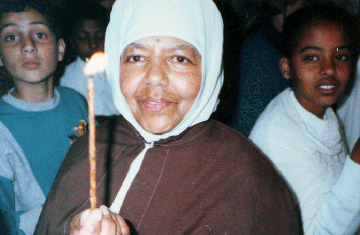
Sunday with Emahoy(nun) Tsege Mariam


By Anko Zuta, Blogger of De Birhan Blogspot
03/04/2011
Sundays are so boring in this part of the world, I am living. Hardly possible it is to listen to a bird’s or a girl’s song. I can’t even start my University assignment, I am procrastinating. My last resort was googling and I found this cool stuff while googling. The history of Emahoy(nun) Tsege Mariam and her composition. Emahoy(Nun) Tsege now over 85 years old is the first Ethiopian classical musical composer , now residing in an Ethiopian Orthodox Church Monastery in the Holyland Jerusalem, Israel.
Emahoy Tsegue in Bethlehem

A short biography of Emahoy(nun) Tsege Mariam available on this web (http://www.emahoymusicfoundation.org/home.html) contains the following information , “Yewubdar Gebru was born in Addis Abeba on December 12, 1923 to a privileged family. Her father Kentiba Gebru and her mother Kassaye Yelemtu both had a place in high society. Yewubdar was sent to Switzerland at the age of six along with her sister Senedu Gebru. Both attended a girls' boarding school where Yewubdar studied the violin and then the piano. She gave her first violin recital at the age of ten. She returned to Ethiopia in 1933 to continue her studies at the Empress Menen Secondary School. In 1937 young Yewubdar and her family were taken prisoners of war by the Italians and deported to the island of Asinara, north of Sardinia, and later to Mercogliano near Naples.”
Young Yewubdar secretly fled Addis Abeba at the age of 19 to enter the Guishen Mariam monastery in the Wello region where she had once before visited with her mother. She served two years in the monastery and was ordained a nun at the age of 21. Emahoy left Ethiopia following her mother's death in 1984 and fled to Jerusalem, Israel because socialist doctrine in Ethiopia during the reign of Dictator Mengistu Haile Mariam attacked her religious beliefs. Emahoy is now 85 years old and she plays the piano at the monastery nearly seven hours a day, she continues to write new solo piano compositions. Emahoy has been recognized by many music critics around the world and there is a growing interest in her life and her music by international media including Le Monde, BBC, and Canada TV, the Emahoy Tsege Mariam Foundation Website explains.
Her composition that I uploaded above meets my recency (The homeless wonderer) and is a good pill for me to finish this unexciting Sunday.

I hope to meet her when I go to Jerusalem in the near future.

Friday, April 1, 2011

Alemu Seme of OPDO goes to China

By Anko Zuta,Blogger of De Birhan Blogspot
01-04-2011

Alemu Seme, who was at the head of the Oromia Investment Commission, and one of the leaders of the Oromo People Democratic Organisation (OPDO) has just been sent to study in China. This decision was made by Azeb Mesfin and Meles. Alemu was helped to escape the current OPDO arrest fever by Azeb as he had a lot of scandalous and corrupt relationships with her.
Particularly in illegal land sales. Alemu owns huge land himself in different parts of Oromia region.
Senior figures of OPDO and Oromia Investment Commission are being arrested due to corruption related and political causes.

Related Posts Plugin for WordPress, Blogger...