Tuesday, January 25, 2011

populaire de la révolution


By Ankober Zuta ,DebreBirhan Blogspot’s Staffer

25/1/11

Sinteya is a colleague from Central Africa, here in the country I live. We have roved around issues of genre from racism to humanity, sex, unemployment and Africa. Tunisia and the revolution was the most conspicuous of them. She says “I am not wondered about the revolution in Tunisia.” She posits that revolution was a result of modernisation and ‘neutral’ army. “As you saw, the high literacy rate and technological advancements and the refusal of the army general to shoot the people was the reason for the revolution’’.

She was also doubtful of the repeatability of the Tunisian case in other African countries as, mainly, the military is partial.

What would the military do if Ethiopians rise up tomorrow like the Tunisians?

Neamin Zeleke in his May 2009 article wrote:

Ginbot 7‘s latest statement provides a comprehensive list of the key and commanding positions held by Tigrayns in the military. By any stretch of imagination, it is not possible that 6% of the population have the unique capacity to command and control 95% of the command posts in the military. It is not possible by any kind of qualitative measurement for promotion — merit, experience, education and other criteria — that a single and minority ethnic group would have what it takes to hold 57 out of the 61 key and mission critical positions within the national military. Nothing can be further from the truth; the only thing that they have is their ethnicity and political loyalty to be able to totally dominate the military in such grossly disproportional ratio. This is the penultimate and most central point that comes out very loud and clear indeed.

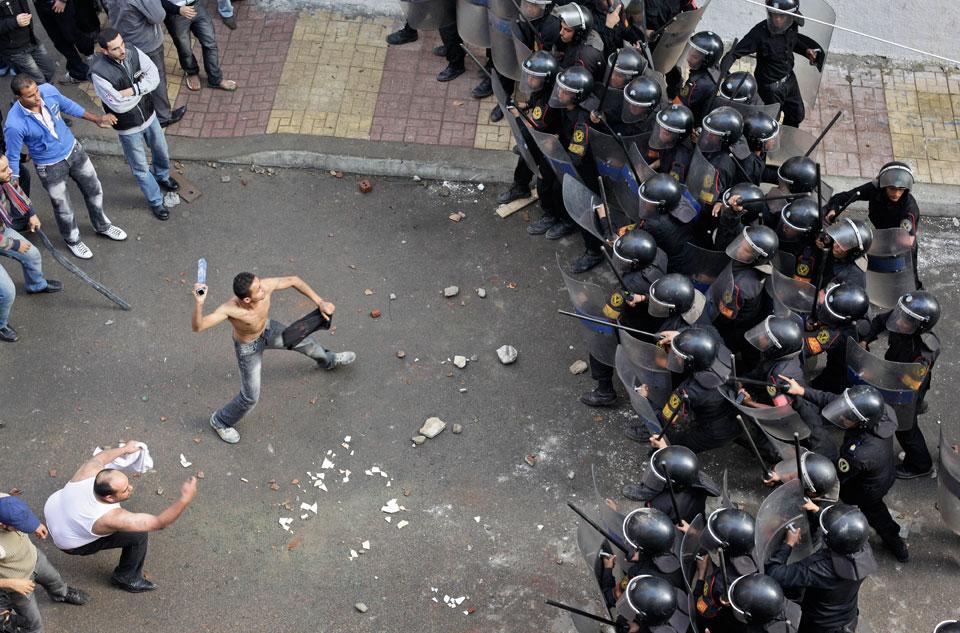
Can a force of the above make up stand and say no I won’t shoot peaceful demonstrators? When will Ethiopia and Africa in general, have an army that is managed by civilians? When will it be accountable and free from monopoly?

G/Tsadkan Gebretensae formerly Lieutenant General was a ‘’liberation fighter’’ with the Tigray People’s Liberation Front (TPLF), first as a rank and file fighter and rose through the ranks to be a senior member of the TPLF leadership. During the armed struggle for over 15 years, he played a crucial role in building and commanding the TPLF army, until his transition to the position of Chief of the General Staff of the new Ethiopian National Defense Forces (ENDF) from 1991 to 2001. During this period he led the transition of the liberation army of the Ethiopian People’s Revolutionary Democratic Front (EPRDF still the ruling party) into a conventional National defense force, and commanded the Armed forces in the war against Eritrea. He has received his Masters in International Policy and Practice from the Elliott School of International Affairs, George Washington University and Masters in Business Administration (MBA) from the UK Open University. Since 2002 in a row that occurred within the party his military recognition was removed by Meles Zenawi. Since then he is just Tsadkan now. Currently he is in the process of forming the Raya Beer S.C. with Eyesusworq Zafu , the president of the Ethiopian Chamber of Commerce and Sectoral Associations and chief executive of United Bank S.C.

Seventeen years ago, when Ethiopia was under a Transitional Government (I was just 11 then by the way) was in power Tsadkan presented a compelling paper, knowingly or unknowingly.

On the a symposium “on the Making of The New Ethiopian Constitution held Addis-Ababa from 17-21 May 1993'' , General Tsadkan Gebretensae then Chief of the General Staff Armed Forces of the Transitional Government of Ethiopia had this compellingly smart vision of an Ethiopian army. As the paper was eight pages- I select and present some of his wonderful visions that had been lost in the air.

“I would like to preface my comments by stating that the views I am expressing are my own, and not the official views of either the EPRDF or of the Ministry of Defense of the Transitional Government of Ethiopia. I hope that my comments, which I base on my own experience and an analysis of the role of the military in the past, will prove useful to the debate and discussion taking place at this Symposium. ” he kicks of his paper.

Tsadkan then envisioning the purpose of the national army says

“The purpose of the national army must be defined by the constitution. The future national army cannot be an instrument to suppress internal political dissent or to resolve political problems, within Ethiopia, that should be resolved politically and democratically. ”

The military must obtain its direction from the constitution, and the constitution should be the instrument for informing the social and political consciousness of the armed forces. The national army must be guided by and be loyal to the constitution. But to defend the constitution, the army must know and understand the principles and articles that the constitution upholds, he had viewed.

On the command of the army he viewed,

“The command of the national army must rest with the elected civilian authorities. The highest legislative authority in the country must determine the size, structure and budget of the army if civilian control of the armed forces is to be guaranteed... This understanding can be achieved by increasing the level of public understanding and debate about the military and military matters, and by ensuring that the national army operates with transparency.”

Accountably

Regarding the issue of accountability Tsadkan’s spot was

“If the national army is to be credible, and to function as a guardian of peace in the eyes of the population, it must be accountable at several levels. In general, the national army should be accountable to civilian authorities in the execution of its mission. This means that, as stated above, the highest legislative body of the land would determine the army’s size, structure and budget...

He said this accountability was critical for a number of reasons. First, it demonstrates to the civil society that the military is not above the law and thus cannot abuse its power. Second; it reinforces the understanding of legal and democratic principles within the army itself, thus ensuring better democratic practice and a commonality of purpose between the army and the civilian population.

Composition of the National Army

This was the section that grabbed my psyche. He said “The national army of Ethiopia must be broadly representative of the society.”

He continues

“This does not mean that its composition should be based on an ethnic quota system, but that it must be truly national in character and sufficient diversity to allow the people of Ethiopia to feel ownership. The army must be their army. Therefore, the army must be composed in such a way as to serve as a symbol of Ethiopia’s diversity and of its unity. To function as a national army, the military must be under a central command and can’t be composed of various ethnic armies. Rather, the army must involve and include all the peoples of the country and foster a relationship between and among them that is based on mutual respect and equality. If the military demonstrates, by its composition and internal life, that it respects the equal rights of all people, that it is representative of Ethiopia, it can also support the quest for unity with equality throughout the entire country.”

The following statements show how really visionary Tsadkan was and makes him the first Tigrean to criticise the army’s monopoly under one ethnic group.

“The existing army, which is mandated to serve during the transitional period, is not, for historical reasons, as representative as it should be. This fast has caused some difficulties during the transition, and needs to be rectified. In order to do so, it will be necessary to demobilize many Tigrian members of the armed forces and to re-shape the army to reflect the participation of all nations and nationalities. Demobilization is a process that must be undertaken carefully and with a long-term view towards providing former combatants with a viable economic alternative. It is therefore a responsibility that the government must assume, and the people must support. ”

Summary

Tsadkan summarised his vision paper of Ethiopia’s army with these bullets for a democratic Ethiopia:

1) The definition of clear purpose for the army.

2) A political awareness, within the army, of the constitution and of its role in defending and promoting that constitution.

3) Democratic internal management of the army.

4) An integrated relationship between the army and the civilian population.

5) Control of the armed forces by civilian authorities.

6) Accountability of the army to the people and their elected representatives.

7) An army of a size that is realistic and affordable.

8) An army which is composed to reflect the diversity and unity of Ethiopia.

The approach of building a barracks army has led Ethiopia to disaster in the past, and we should not repeat that failed experiment, he asserts.

“In the absence of such measures, not only will the army be incapable of contributing to democracy, but it will cease to function as an effective fighting force because the entire arrangement depends upon popular support for and confidences in the army which can only come from the democratization of society.” Tsadkan concludes.

I like Tsadkan’s hallucinations. Hallucinations that went with the wind.I don’t know why it was hidden and not much was written about his vision. He is one good fella that would ‘perhaps’ say no or grumble had he been asked to shoot peaceful demonstrators. Egypt is roaring in protests the most closest and likeliest nation is Ethiopia.

Will the real Tsadkan please stand up/back and help his/your people? Will you shift from business and use your amazing head to realise your vision?

Just a clarion call from a tiny compatriot.

Full paper: http://www.cprdhorn.org/AVISIONOFANEWARMYFORETHOIPIA.pdf

Friday, January 21, 2011

An ambassador who makes waves

Girma Asmerom,born in DebreBirhan town to Eritrean parents is the new Eritrean envoy to the AU

The Eritrean opposition is displeased that Ethiopia has accepted the appointment of Girma Asmerom as Ambassador of Eritrea to the AU in Addis Ababa.

The former ambassador to the Organisation of African Unity (OAU) in Addis Ababa, who was declared persona non grata by the Ethiopian authorities in 1999, is back in the Ethiopian capital. Girma Asmerom Tesfay presented his letters of accreditation there to the President of the African Union (AU) Jean Ping, on 17 January, as the new Eritrean permanent representative to the AU. Given his personality, this appointment is not to the liking of the Ethiopia-based Eritrean oppostion, which is annoyed with Prime Minister Meles Zenawi for not opposing it. Girma Asmerom Tesfay was a member of the Ethiopian national football team in the 1968 Olympic Games in Mexico City and so is accustomed to stating privately that he is “more Ethiopian than Meles Zenawi ”. For his part, the Ethiopian Prime Minister holds him responsible for the degradation of his relations with the Eritrean Head of State, Issayas Afeworki, after Eritrea achieved independence in 1993. Girma Asmerom Tesfay knows Ethiopians and Addis Ababa well, which raises concern among the Eritrean opposition that he might form a pro-Eritrean network of influence in the Ethiopian capital.

Link to the news : http://www.africaintelligence.com/ION/politics-power/2011/01/22/an-ambassador-who-makes-waves%2C87609998-GRA-login

Friday, January 14, 2011

Watch out Djibouti!

Djibouti in red


Omar Guelleh , Meles’ replica could make Djibouti the next Somalia...

By Ankober,DebreBirhan Blogspot’s Staffer 14/1/11

I am sitting in the sitting room of a place where most Africans spend their time. It isn’t in Ethiopia or Djibouti, but in the West. The young gentleman besides me is a Somalia brother who hails from Mogadishu. Hassen is one the best visionary, optimist and peace loving African brothers I met from the Horn. Not only has that Hassen been trained in Military Science, Foreign Policy and Security Studies. Listening to his succulent analysis and predictions of the imminent political endowments and possible security transactions likely to occur in the Horn of Africa makes you say “what if the day didn’t end”. Interested with our questions I flooded him with questions “What do you think about the Referendum in the South and its implication on Somalia?”, “Do you think the Transitional Government in Somalia will live long and bring peace to that Nation?”, “How strategic is the Horn in international and regional peace and security?”, these and many other questions, he says “wooooo ,,, hold on man! I can’t answer all these now. I need to research them. But I can say something about Djibouti now” he said.

For him of all the East African/Horn of African nations, the most to be worried of and watch out is Djibouti. “Watch out Djibouti”, he warns.

Djibouti, a small nation of around one million people, bordered by Eritrea in the north, Ethiopia in the west and south, and Somalia in the southeast is strategically located within the Red Sea and the Gulf of Aden. Predominantly Islam, Djibouti was declared an independent nation in 1977 from France but still maintains deep French relations, and through various military and economic agreements with France, and receives continued security and economic assistance. It is also serves as a military base for the United States of America and Japanese forces.

President Ismael Omar Guelleh, who succeeded his uncle, Hassan Gouled Aptidon in 1999, is criticised for increasingly being corrupt and dictator.

“The President is the cause for the possible instability in Djibouti and the Horn. Since coming to power he has changed himself into being totally authoritarian by changing the whole administrative system and cracking down on oppositions and pillars of democracy’’ Hassen analyses.

According to Hassen , this self aggrandizing nature of the Presindent has gigantic similarities with the former President of Somalia , Mohamed Siad Barre (1919-95) and current dicatators in the Horn such as Meles Zenawi of Ethiopia and Omar Hassan Ahmad al-Bashir of the Sudan. “they all show a facade face of democraticness, pro freemarketedness and capitalistic and readiness to development”.

However, he says Guelleh is of the same creed as those of his neighbouring dictatorial counterparts that foul play the Western ‘ideals’ and ‘rhetoric ’.

From the historical and current military, security, racial and economic analysis I did on Djibouti, i dare to say that I fear that that Nation and the President himself are sitting on a ‘time bomb’.

Djibouti will conduct its Presidential Election at the end of April/beginning of May 2011.And this is where the core of his dictatorialness and possible downfall lies. The parliament approved a constitutional amendment removing term limits allowing the current president Ismail Omar Guelleh to run for the third term, a move made clearly in preparation for the forthcoming elections in May 2011.Guelleh has been elected in 2005 in what was seen as a one-man Presidential elections since he was the sole candidate of the Union for a Presidential Majority (UPM). Africannewsanalysis.blogspot.com reported in 2010 that Djibouti's parliament approved a constitutional amendment allowing President Ismael Omar Guelleh to run for a third term. It "The procedure is that the bill should be adopted at its first reading by the Assembly," the speaker of the National Assembly Idriss Arnaoud Ali said. "Thereafter the president of the republic can either decide to hold a referendum to validate the constitutional amendment or he can ask members of parliament to examine the law a second time, in which case it must be passed by two thirds of them," he explained.

According to Hassen, although some analysts say that the President forced the constitutional amendment with a hope of “preventing his regime from imploding from the divisions between certain dignitaries in his Mamassan clan and the dominant Issak network (the clan from Somaliland) of his wife Kadra Mahamoud Haïd’’ ,the fact is that he did it with the sole aim of continuing his rule till the doomsday.

Hassen said that the economy, military and civil service an governmental posts are all controlled by members of Guelleh’s clan. A once foreign spy ,Guelleh in a similar manner to his counterpart Meles Zenawi who vested all the nucleus powers for Tigreans and particularly the Adwa network , concentrated all the important military and governmental powers within in his Mamassan clan and the dominant Issak network.

As to Hassen , this trend will return Djibouti to its civil war of 1991 to 2000. “this centralisation of power within one ethnic group and mainly within the President himself shows a typical similarity with the then day of Barre’s Somali”.

As to somalidiasporanews.com ,despite huge cash flow generated from foreign investors in the country –Djibouti hosts three key military bases belonging to high profile Western countries namely France , the USA and, Japan. It also houses the international center for fighting piracy. The country is the only maritime outlet for Ethiopia, a nation of 60 million consumers .In a word Djibouti could be the Dubai of East of Africa had it been properly managed and well run. Instead it has become the hub for money laundering, chronic corruption and ill -governance .Rumours say O.Guelleh to be one of the top three richest men in Africa. This money, scattered in different corners of the planet to avoid any probe or inquisitive eye, is of course the money stolen from Djiboutian people. Things are, unfortunately, going to worsen if president Guelleh clings to power beyond 2011 and the country could pay a heavy price for this lack of democratic change.

“Guelleh's government has been criticized by human-rights groups because of his regime's determination to maintain political stability. Members of his family's Mamassans clan hold positions of power in the cabinet and government, the Rassemblement Populaire Pour le Progres/People's Rally for Progress (RPP) remains the dominant political force, and there have been charges that opposition groups, such as a predominantly Afar rebel group, the Front for the Restoration of Unity and Democracy (FRUD) and the Union of Democratic Alliance (UAD), are unable to operate freely. FRUD has called upon other nations, especially the United States and France, to back a more aggressive transition toward democracy in the country. To his credit, Guelleh has made some efforts to lessen tensions with the Afar minority, but the potentially troubling situation was not diminished in the election of 2005. He ran on campaign promises to reduce poverty and increase women's rights and roles in the country, but the UAD called for a boycott of the election, and FRUD subsequently issued a statement of support for the boycott.” notablebiographies.com reported last year.

Guelleh, dismisses the charges.

On a notable crackdown on the media, following his 'Big Brother' Meles Zenawi’s footsteps threatened to jail people who listen to Voice of Djibouti, a prodemocracy radio opened by young Djiboutians in the Diaspora.

Union for Democratic Change (UAD) and other opposition parties such as the DSM, the ARD and the UDJ are regrouping and mobilizing the vast majority of Djibouti’s population for change.

Geulleh, owns several businesses from shops, hotels, factories to service providers all located in various African countries. His hotel in Dire Dawa, Ethiopia is a good example.

The younger counterpart of Semehal Meles, Meles Zenawi’s daughter, Haïbado Ismail Omar, the youngest daughter of the Head of State, aged just 25 years, has been assigned by her father ,President Guelleh to be the Djbouti’s official adviser for economic affairs under Presidential Decree in August 2010, just as she left the benches of the Colombia University. Similar or even higher post awaits, Semhal as she completes her study in the UK.

The generality of all these state of affairs in Djibouti added with the same tension and time bombs in Ethiopia, Sudan and Eritrea could soon burst out to form a region that is unstable, uncontrollable, genocidal , maritime pirate infesting and apocalyptic .

As a recommendable input, I choose to use Obang Metho’s , Executive Director of the Solidarity Movement for a New Ethiopia (SMNE) words he wrote for the “Ethiopia and the Horn of Africa Conference on Governance, Peace, Security and Development “ held from April 9-11, 2010 in Washington DC.

“... now it is up to Ethiopians and people of the Horn, from all different points of view, to come together to listen, learn, think, debate and discuss how we all might better work together to bring about an inclusive society where “humanity comes before ethnicity,” or any other distinctions and where the solutions we seek are not for one chosen group to the disadvantage of others, but for all of us, for “no one will be free until all are free.”

Friday, January 7, 2011

In the face of ‘free will’, Citizens of Northern Sudan drink the inconvenient truth

Over 5000 Ethiopians emigrating to Sudan every week

By Ankober,DebreBirhan Blogspot’s Staffer 07/1/11

Happy Genna Guys!!!

The Southern Sudan will possibly decide on its own fate just after two days, on 9th,January 2011.This landmark event in the history of the contemporary world will be highly watched the world over. Issues of secession, separation and independence or such countries have not been a common scene since the second world war except Eritrea and few others.

Stanford Encyclopaedia of Philosophy, 2010 revision defines “Free Will” as a philosophical term of art for a particular sort of capacity of rational agents to choose a course of action from among various alternatives. Most philosophers suppose that the concept of free will is very closely connected to the concept of moral responsibility. Acting with free will, on such views, is just to satisfy the metaphysical requirement on being responsible for one's action.

While another definition puts it as “Free will is the putative ability of agents to make choices free from certain kinds of constraints. Historically, the constraint of dominant concern has been the metaphysical constraint of determinism. The opposing positions within that debate are metaphysical libertarianism, the claim that determinism is false and thus that free will exists (or is at least possible); and hard determinism, the claim that determinism is true and thus that free will does not exist.

Philosopher and esotericist Rudolf Steiner in his historic book, The Philosophy of Freedom, 1893, centring on the concept of free will, divides the problem of free will into freedom of thought and freedom of action. He argues that inner freedom is achieved when we bridge the gap between our perception, which reflect the outer appearance of the world, and our cognition, which give us access to the inner structure of the world; and that outer freedom arises when we bridge the gap between our ideals and the constraints of external reality, letting our deeds be inspired by what he terms moral imagination. Steiner considers inner and outer freedom as integral to one another, and that true freedom is only achieved when they are united.

Steiner concludes by pointing out that to achieve this level of freedom, we must lift ourselves out of our group-existence: out of the prejudices we receive from our family, nation, ethnic group and religion, and all that we inherit from the past that limits our creative and imaginative capacity to meet the world directly. Only when we realize our potential to be a unique individual are we free. Thus, it lies in our freedom to achieve freedom; put another way, only when we actively strive towards freedom do we have some chance of attaining it.

Opposite to the conception of ‘free will’ the theory of “determinism’’ exists. "Determinism" is the name of a broader philosophical view that conjectures that every type of event, including human cognition (behaviour, decision, and action) is causally determined by previous events. In philosophical arguments, the concept of determinism in the domain of human action is often contrasted with free will. The argument called indeterminism (otherwise "nondeterminism") negates causality as a factor and contradicts deterministic argument. Determinists believe the universe is fully governed by causal laws resulting in only one possible state at any point in time. With numerous historical debates, many varieties and philosophical positions on the subject of determinism exist, most prominently the free will debates involving compatibilism and incompatibilism. Predeterminism proposes there is an unbroken chain of prior occurrences back to the origin of the universe. Refer Wikipedia and the web for details.

Today I was chatting here with my Sudanese pal on the Referendum issue. This lad comes from the Northern part of Sudan. He said “i am totally against the idea of separation. South Sudan shouldn’t separate from us. The historical, cultural, economic and blood relationship we formed between us compels us to live together. I heard that this past week Southern and Northern Sudanese singers have been singing about unity in concerts held in the Sudanese Capital.’’

As to him, although there has been an adverse relationship between the two Sudan’s and the South has been marginalised and abused by the North, it was a must that they lived together forever. No Separation. This is the unanimous utterance that you hear from almost all Sudanese in the North and the Capital. The opposite echoes from the South.

"I never expected to see the day when my country would be split in two," Bashir Makkawi, a Sudanese resident in the United Arab Emirates told Gulf News recently. "They feel like second class citizens in Sudan, and believe that they will get their full rights in an independent state… but I don't think the south will be able to cope on its own," he said.

I will, in short try to see the above comments against the two theories. I sect the Southern Sudanese with the ‘free will’ concept and the Northern’s with the ‘determinism’ one.

The Southerners who have been marginalised, abused, let down and enslaved within their own country had to fight for their freedom and self determination. On the 9th January,2011 among various alternatives , they will choose a course of action rationally: freedom, session and independence. This choice can’t be interceded by any factor.This is what is called 'free will'.

Put by Steiner beautifully and adapted by me ''unhindered by determinism, they lifted themselves out of the group-existence: out of the prejudices they receive from our family, nation, ethnic group and religion, and all that they inherited from the past that limited their creative and imaginative capacity to meet the world directly.''

On the other hand, the Northern ‘Determinists’ conceive that the Southerners are bound to live together with the North determined by prior states and history. As to my credible interviewees although Al Bashier and few of his Cabinet members publically appear to support the ‘free will ‘of the Southerners, they rather tacitly are against to it. Some members of the constitutional council, politicians and the majority of the citizens of the North are ‘unhappy’ about Sunday’s referendum. However, in spite of this, Northern Sudan is being compelled to drink the inconvenient truth simply by the power of ‘free will’.

Regional Impact of the Referendum: emigration

Security and peace experts of the Horn of Africa are predicting political and military tensions and ‘ a probable war ’ as a result of the Referendum. Whatever, the outcome may be, the Referendum will have a huge socio-political and economic impact in the Horn and in international relationships.

One of the effects that is more visible prior to the Referendum is emigration. Workers from Ethiopia and Eritrea are emigrating in droves to Khartoum and Juba in anticipation of finding jobs. To Khartoum : to grab the jobs that over 1.5 Southerners are vacating as they return to their new homeland and to Juba hoping to start business utilising the opportunities and resources that would be created as a result of the separation.

According to sources from Addis Abeba, over 5000 Ethiopian workers, mostly females are heading to Sudan to work as house maids and in industries. Approximately 5000 to 8000 Ethiopians block the road to Sar Bet every Monday when they assemble to make visa applications to travel to Sudan.In addition to this, there are an undocumented number of Ethiopians that are going to Sudan via the Metema border.

Once a poor and civil war hit Sudan, is now in need of cheap labour as a result of wealth that has sprung due to oil discovery and budding factories i.e. sugar factories. The price of commodity like in Addis Abeba, has gone over the roof in Khartoum.There is also a political tension as most of the opposition groups,National Consensus Forces (NCF) are coming together to form a coalition and overthrow Al Bashier for once.

I don’t know what our political strategists wish or are currently strategizing to make use of the Referendum to overthrow , the Meles Zenawi Government , I wish that the Referendum may conclude in peace.

Friday, December 31, 2010

Mo Ibrahim vs Al Amoudi


Vs


By Ankober,DebreBirhan Blogspot’s Staffer 31/12/10

In the parable of the Prodigal Son, the brother who always obeys his father is furious at seeing the rebel son received with celebrations and joy. In the same way, many people who are obedient to the Lord’s word, end up becoming the merciless hangmen of all those who one day strayed from the Law.

In a small village in the interior, a well-known sinner was barred from entering the church.

He was angry and prayed:

“Jesus, hear me. They will not let me into your house, for they think I am not worthy.”

“Do not worry, my son,” answered Jesus. “I too am on the outside, together with those I have always stood alongside - sinners like yourself.”

The above excerpt is from the Warrior of the Light - Volume 3 by Paulo Coelho, 2008.

Dear fellas! Readers of this blog!

Hours before writing this opinion piece, I was chillin in one of the social media spots that I spend my recess often at. There, I got some people complementing me and other demoting my opinion and items. Well that is how the ‘world of blogosphere and cyber sphere’ is. 2011 is almost in. Many wish the new-year to be a year of ‘freedom’, ‘prosperity’ and ‘success’ and most importantly, our country becomes the real ‘utopia’. Luckily, we celebrate two new years, ours and theirs. However, a heartbreaking story of our brothers and sisters just produced by beebs (http://www.bbc.co.uk/news/world-middle-east-12089445) filled the eve with grieve .The report complements Paulo’s excerpt above.

I, for one, wish the New Year may bring us all the most and best. Hoping that these wishes could come true through the concerted efforts of Ethiopia’s individual citizens and collective actions of all forms of cooperatives inside and outside of our beloved motherland, I propose that some ‘great’ individuals of the country should make use of their knowledge, potential and wealth more than any other time now. One of these men that I think could do a lot for the betterment of Ethiopia and Africa but have used their potentials little or misused it is the Saudi-Ethiopian tycoon, Sheikh Mohammed Hussein Ali Al Amoudi. Here with I make a short comparative analysis of two African tycoons: Dr. Mohamed "Mo" Ibrahim and Al Amoudi.

1) Similarities

Similarities

Mohamed Ibrahim

Mohammed Al Amoudi

Date of Birth

1946

1946

Religion

Muslim

Muslim

Dual Nationality

Sudanese-British

Ethiopian/Saudi Arabian

Education

Ph.D from the University of Birmingham in mobile communications

holds an Honorary Doctorate in Philosophy from the Addis Ababa University

Investment focus

East Africa, Worldwide

East Africa, Worldwide

2) Differences

2.1 Business specialisations

One of the major of differences between Dr. Mohamed "Mo" Ibrahim and Mohamed Al Amoudi is their business specialisation. Mo. Ibrahim an entrepreneurial communications professional has generated his wealth from this knowledge oriented business sector becoming one of the few billionaires in the world. In 1989 he founded MSI, a consultancy and software company, which was bought by Marconi in 2000. In 1998, MSI spun off MSI-Cellular Investments, later renamed Celtel, as a mobile phone operator in Africa. According to the Forbes 2008 Rich List, Mo Ibrahim is worth $2.5 billion. Mo Ibrahim was selected for the TIME 100 list in 2008. He was also recognised by EETIMES as one of 35 people, places and things to watch out for in 2008.He was also recognised for doing ethical business and executing proper Corporate Social Responsibility.

While Al Amoudi’s wealth emanates majorly from oil trade and has now encompassed a conglomerate model. He owns a broad portfolio of businesses not only in oil but also in mining, agriculture, hotels, hospitals, finance, operations and maintenance. Al Amoudi made his fortune in construction and real estate before branching out to buy oil refineries in Sweden and Morocco. He is said to be the largest foreign investor in both Sweden and Ethiopia. In 2008, Forbes ranked Mohammed Al Amoudi as the 97th richest person in the world with a net worth of $9 billion. In 2009, Forbes ranked Mohammed Al Amoudi as the 43rd richest person in the world at a net worth of $9 billion. Al Amoudi has been criticised various times for dong an unethical business. He has been criticised by local press in Ethiopia for being a ‘rent seeker’ and land and property ‘grabber’. At times, residents in his business areas have protested his ‘illegal and irresponsible’ business eg. The protests of the residents of Legedembi Gold Mine are some.

2.3 Political Difference

In terms of political stand, Mo. Ibrahim remains to be fully independent and neutral of any political affiliation. Albeit, he is highly involved in political events and program that concern the continent of Africa via his Foundation, The Mo Ibrahim Foundation, Ibrahim never has affiliated himself with any political party or ideology in his native Sudan or in the international politics. He has always called and publicly prayed for peace and understanding in Sudan between all sides and forces.

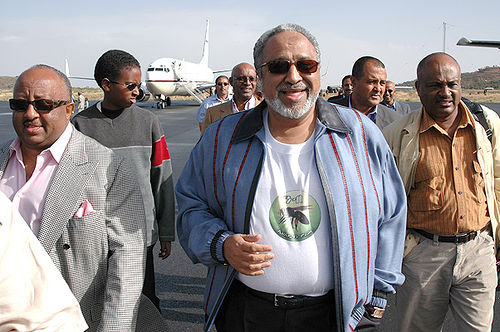
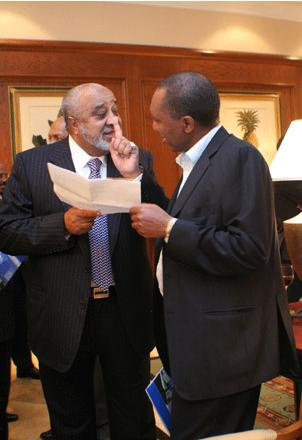
Al Amoudi on the other hand, has been an ardent financer and supporter of the Tigrean People’s Liberation Front (TPLF), the head ruling wing of EPRDF party and was donating money to Clinton Foundation. He was seen wearing a t-shirt bearing the election logo of the ruling party, bee. Al Amoudi was named as one of the Clinton Foundation Donors, according to information released as part of an obligation placed on former President Clinton when he supported Hillary Clinton's nomination as Secretary of State. Al Amoudi is reported to have donated between $1,000,001 to $5,000,000.The photos above portray Al Amudi’s political inclination and outright support of the current ruling party in Ethiopia and Foundation’s and parties the world over. As the pictures tell for themselves, there is no need for caption or explanation.


2.4 Vision, Dream and Goal

I was prompted to write this article when I accidentally came across this video (http://www.moibrahimfoundation.org/en) found in the middle of the page as you enter the Mo Ibrahim Foundation's official website. The video was screened on the weekend of 20 and 21 November, 2010 when the Mo Ibrahim Foundation hosted a cultural celebration and discussion forum on regional economic integration of Africa in Mauritius. The speakers ranging from Mo Ibrahim himself to, Dr Navinchandra Ramgoolam, Prime Minister of the Republic of Mauritius ,country rated as the most democratic in the past year by the Foundation, Donald Kiberuka of the African Development Bank (ADB),and many other African academics, civil society leaders, investors and politicians from all over Africa attended the forum. The program was stunning. So blessed with positive visions, dreams and goal and visionary Africans and concluding with an action plan. The man behind all this was Mo Ibrahim doing it through his Foundation, the Mo. Ibrahim Foundation. Established in 2006, the Mo Ibrahim Foundation aims to support good governance and great leadership in Africa. The Foundation works to: Stimulate debate on good governance, provide criteria by which citizens and governments can measure progress, recognise achievement in African leadership and provide a practical way in which leaders can build positive legacies on the continent when they have left office and support aspiring leaders for the African continent.

According to Ibrahim, "Good governance is crucial." With a $5 million initial payment, plus $200,000 a year for life, the prize is believed to be the world's largest, exceeding the $1.3m Nobel Peace Prize. Former South African President Nelson Mandela, former United States President Bill Clinton, and former United Nations Secretary General Kofi Annan are among those who have welcomed the initiative. The inaugural Prize was awarded to former president Joaquim Chissano of Mozambique, for "his role in leading Mozambique from conflict to peace and democracy." Festus Mogae won the 2008 Ibrahim Prize for Achievement in African Leadership, and will receive US$ 5 million over 10 years and US$ 200,000 annually for life thereafter.

The information available on the Foundation’s site states “the Foundation publishes the Ibrahim Index of African Governance, ranking the performance of all 53 African countries. Until 2009, the Index took into account only the 48 countries in sub-Saharan Africa. Countries are graded on factors which fall into four main categories: Safety and rule of law, sustainable economic opportunity, human development, and participation and human rights.’’

The Foundation is committed to supporting great an African leadership that will improve the economic and social prospects of the people of Africa.

He says development cannot be achieved without good governance. Good governance ensures that all of a country's resources are harnessed effectively and fairly to translate into improved quality of life for its people. Every arena, from healthcare to environmental stewardship, from education to human and political rights, is affected by the quality and nature of governance. While there have been improvements in many African countries recently, weaknesses in governance and leadership capacity are central to the issues currently facing the continent.

Well I think this is what Africa needs at this moment. Precious child of Africa, Ibrahim works for the safety, development and prosperity of Africans. He has no political party that he supports but enterprisingly sweats for the freedom, equality and justice of Africans including his native Sudan. He encourages all parties and politicians to step up together with the common denominator of good governance than the prosperity of few political parties, junta or clique.

To the contrary, our Al Amoudi doesn’t do any of the above. He is the opposite of all the above , except his few donations to hospitals, NGOs and individuals and few other causes in Ethiopia and else, he is not recorded doing anything meaningful in terms of good governance ,democracy ,equality or peace and tranquillity in Africa or his native Ethiopia.

Still compared with Ibrahim, Al Amoudi’s philanthropic activities such as the building of a 140-bed health care facility that supports visual impairment, disabled, children's health, works in poverty alleviation programmes, overseas scholarships and sponsoring of the CECAFA Cup, Africa's oldest cup competition for the last three years, can’t even reach one third of Ibrahim’s philanthropic works. I have heard of him saying that he is so committed for the progress and development of Ethiopia but I doubt if he meant it really or has really found out how he can realise the vision. Maybe he needs better advisors. Making huge investments and employing thousands of jobless Ethiopians can in no way be viewed as a success or improving Ethiopia. Ethiopia could be developed when the society cross sectionally gets fair access to resources, is empowered, is free, is equal and good governance is achieved.

Being an ardent supporter of the ruling party would only alienate and diminish the tycoon that could be looked up as model and icon of success by the Ethiopian (African) youth. Al Amoudi has lost huge credibility from the opposition parties in Ethiopia, their supporters, media and independent analysts due to his open support of the ruling party in Ethiopia .He has compromised his independence, neutrality and moral integrity. His financial, moral and investment role and support with the current regime in Ethiopia makes him an indirect perpetrator and elongator of the human rights abuse and the regime’s life span, as to many.

Unlike Ibrahim, he followed the Chinese model of non interference and neglected the abuse of human rights in the country. He never spoke of inhuman treatment of citizens in Ethiopia or Africa.

If Ibrahim progresses with his current pace and scope, his Foundation would be able to succeed in creating an Africa that is well governed, free, democratic and developed in less than a decade. If his vision, dreams and goals were followed or were at least assisted by tycoons like Al Amoudi, the achievement could be in the offing.

To support this write up with a strong literature on the role of investors and tycoons in good governance or the prevalence of democratic system, I have spent a day with no avail of finding one paper. This tells that the topic area is recommendable for researchers to further investigate.

Paulo Coelho’s piece is an amazing example of the exodus, exile and exclusion of the true children of Ethiopia from the holy land. The ‘false children’ of Ethiopia are now the ones who are inside, some looting, others cooperating in the looting process and many being looted. True children of Ethiopia on the outside, need to be considered worthy and let in and work for the betterment of their motherland.

The vision ,dream and goal of Ibrahim is to root out the central problem of Africa's underdevelopment and backwardness i.e. maladministration or bad governance and instill good governance instead.Al Amoudi's vision, dreams and goals, where as, so far only seem to be making money,money and money.

Gashe Al Amoudi ! It is time to invest on Good Governance!

Related Posts Plugin for WordPress, Blogger...