Monday, October 18, 2010

Ethiopia: Donor Aid Supports Repression

Contributors Should Review Development Programs, Monitor Use of Funds
OCTOBER 19, 2010

(London) - The Ethiopian government is using development aid to suppress political dissent by conditioning access to essential government programs on support for the ruling party, Human Rights Watch said in a report released today. Human Rights Watch urged foreign donors to ensure that their aid is used in an accountable and transparent manner and does not support political repression.

The 105-page report, "Development without Freedom: How Aid Underwrites Repression in Ethiopia," documents the ways in which the Ethiopian government uses donor-supported resources and aid as a tool to consolidate the power of the ruling Ethiopian People's Revolutionary Democratic Front (EPRDF).

"The Ethiopian government is routinely using access to aid as a weapon to control people and crush dissent," said Rona Peligal, Africa director at Human Rights Watch. "If you don't play the ruling party's game, you get shut out. Yet foreign donors are rewarding this behavior with ever-larger sums of development aid."

Ethiopia is one of the world's largest recipients of development aid, more than US$3 billion in 2008 alone. The World Bank and donor nations provide direct support to district governments in Ethiopia for basic services such as health, education, agriculture, and water, and support a "food-for-work" program for some of the country's poorest people. The European Union, the United States, the United Kingdom, and Germany are the largest bilateral donors.

Local officials routinely deny government support to opposition supporters and civil society activists, including rural residents in desperate need of food aid. Foreign aid-funded "capacity-building" programs to improve skills that would aid the country's development are used by the government to indoctrinate school children in party ideology, intimidate teachers, and purge the civil service of people with independent political views.
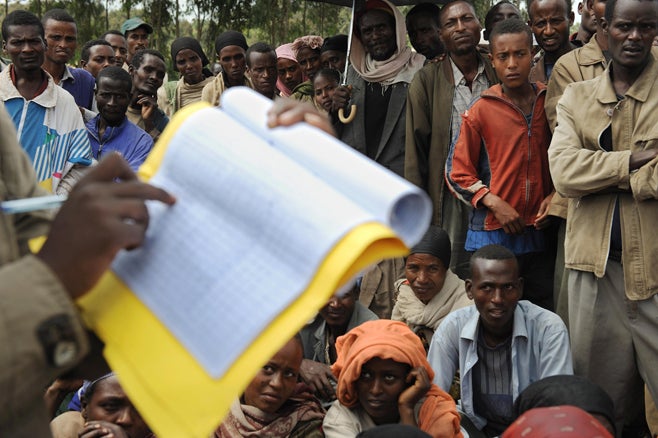
Political repression was particularly pronounced during the period leading up to parliamentary elections in May 2010, in which the ruling party won 99.6 percent of the seats.

Despite government restrictions that make independent research difficult, Human Rights Watch interviewed more than 200 people in 53 villages across three regions of the country during a six-month investigation in 2009. The problems Human Rights Watch found were widespread: residents reported discrimination in many locations.

Farmers described being denied access to agricultural assistance, micro-loans, seeds, and fertilizers because they did not support the ruling party. As one farmer in Amhara region told Human Rights Watch, "[Village] leaders have publicly declared that they will single out opposition members, and those identified as such will be denied ‘privileges.' By that they mean that access to fertilizers, ‘safety net' and even emergency aid will be denied."

Rural villagers reported that many families of opposition members were barred from participation in the food-for-work or "safety net" program, which supports 7 million of Ethiopia's most vulnerable citizens. Scores of opposition members who were denied services by local officials throughout the country reported the same response from ruling party and government officials when they complained: "Ask your own party for help."

Human Rights Watch also documented how high school students, teachers, and civil servants were forced to attend indoctrination sessions on ruling party ideology as part of the capacity-building program funded by foreign governments. Attendees at training sessions reported that they were intimidated and threatened if they did not join the ruling party. Superiors told teachers that ruling party membership was a condition for promotion and training opportunities. Education, especially schools and teacher training, is also heavily supported by donor funds.

"By dominating government at all levels, the ruling party controls all the aid programs," Peligal said. "Without effective, independent monitoring, international aid will continue to be abused to consolidate a repressive single-party state."

In 2005, the World Bank and other donors suspended direct budget support to the Ethiopian government following a post-election crackdown on demonstrators that left 200 people dead, 30,000 detained, and dozens of opposition leaders in jail. At the time, donors expressed fears of "political capture" of donor funds by the ruling party.

Yet aid was soon resumed under a new program, "Protection of Basic Services," that channeled money directly to district governments. These district governments, like the federal administration, are under ruling party control, yet are harder to monitor and more directly involved in day-to-day repression of the population.

During this period the Ethiopian government has steadily closed political space, harassed independent journalists and civil society activists into silence or exile, and violated the rights to freedom of association and expression. A new law on civil society activity, passed in 2009, bars nongovernmental organizations from working on issues related to human rights, good governance, and conflict resolution if they receive more than 10 percent of their funding from foreign sources.

"The few independent organizations that monitored human rights have been eviscerated by government harassment and a pernicious new civil society law," Peligal said. "But these groups are badly needed to ensure aid is not misused."

As Ethiopia's human rights situation has worsened, donors have ramped up assistance. Between 2004 and 2008, international development aid to Ethiopia doubled. According to Ethiopian government data, the country is making strong progress on reducing poverty, and donors are pleased to support Ethiopia's progress toward the United Nations Millennium Development Goals. Yet the price of that progress has been high.

When Human Rights Watch presented its findings to donor officials, many privately acknowledged the worsening human rights situation and the ruling party's growing authoritarian rule. Donor officials from a dozen Western government agencies told Human Rights Watch that they were aware of allegations that donor-supported programs were being used for political repression, but they had no way of knowing the extent of such abuse. In Ethiopia, most monitoring of donor programs is a joint effort alongside Ethiopian government officials.

Yet few donors have been willing to raise their concerns publicly over the possible misuse of their taxpayers' funds. In a desk study and an official response to Human Rights Watch, the donor consortium Development Assistance Group stated that their monitoring mechanisms showed that their programs were working well and that aid was not being "distorted." But no donors have carried out credible, independent investigations into the problem.

Human Rights Watch called on donor country legislatures and audit institutions to examine development aid to Ethiopia to ensure that it is not supporting political repression.

"In their eagerness to show progress in Ethiopia, aid officials are shutting their eyes to the repression lurking behind the official statistics," Peligal said. "Donors who finance the Ethiopian state need to wake up to the fact that some of their aid is contributing to human rights abuses."

Background
Led by the Tigray People's Liberation Front (TPLF), the ruling party is a coalition of ethnic-based groups that came to power in 1991 after ousting the military government of Mengistu Haile Mariam. The government passed a new constitution in 1994 that incorporated fundamental human rights standards, but in practice many of these freedoms have been increasingly restricted during its 19 years in power.

Although the ruling party introduced multiparty elections soon after it came to power in 1991, opposition political parties have faced serious obstruction to their efforts to establish offices, organize, and campaign in national and local elections.

Eight-five percent of Ethiopia's population live in rural areas and, each year, 10 to 20 percent rely on international food relief to survive. Foreign development assistance to Ethiopia has steadily increased since the 1990s, with a temporary plateau during the two-year border war with Eritrea (1998-2000). Ethiopia is now the largest recipient of World Bank funds and foreign aid in Africa.

In 2008, total aid was US$3.3 billion. Of that, the United States contributes around $800 million, much of it in humanitarian and food aid; the European Union contributes $400 million; and the United Kingdom provides $300 million. Ethiopia is widely considered to be making good progress toward some of the UN Millennium Development Goals on reducing poverty, but much of the data originates with the government and is not independently verified.

Quotes from the Report

"There are micro-loans, which everybody goes to take out, but it is very difficult for us, [opposition] members. They say, ‘This is not from your government, it is from the government you hate. Why do you expect something from the government that you hate?'"
- A farmer from southern Ethiopia

"Yesterday in fact the kebele [village] chairman said to me, ‘You are suffering so many problems, why don't you write a letter of regret and join the ruling party?'"
- A farmer with a starving child from southern Ethiopia, denied participation in the safety net food-for-work program

"The safety net is used to buy loyalty to the ruling party. That is money that comes from abroad. Democracy is being compromised by money that comes from abroad. Do those people who send the money know what it is being used for? Let them know that it is being used against democracy."
- A farmer from Amhara region

"It is clear that our money is being moved into political brainwashing."
- Consultant to a major donor, Addis Ababa

"Intimidation is all over, in every area. There is politicization of housing, business, education, agriculture. Many of the people are forced or compromised to join the party because of safety net and so on, many do not have a choice - it is imposed."
- Western donor official, Addis Ababa

"Every tool at their disposal - fertilizer, loans, safety net - is being used to crush the opposition. We know this."
- Senior Western donor official, Addis Ababa

"Which state are we building and how? It could be that we are building the capacity of the state to control and repress."
- World Bank staff member, Addis Abeba

Wednesday, October 13, 2010

Adoptions from Ethiopia rise, bucking global trend

Editors Note: hmmmmmmmmm Adoption!

NEW YORK — As the overall number of international adoptions by Americans plummets, one country — Ethiopia — is emphatically bucking the trend, sending record numbers of children to the U.S. while winning praise for improving orphans' prospects at home.

It's a remarkable, little-publicized trend, unfolding in an impoverished African country with an estimated 5 million orphans and homeless children, on a continent that has been wary of international adoption.

Just six years ago, at the peak of international adoption, there were 284 Ethiopian children among the 22,990 foreign kids adopted by Americans. For the 2010 fiscal year, the State Department projects there will be about 2,500 adoptions from Ethiopia out of fewer than 11,000 overall — and Ethiopia is on the verge of overtaking China as the top source country.

The needs are enormous; many of Ethiopia's orphans live on the streets or in crowded institutions. There's constant wariness, as in many developing countries, that unscrupulous baby-sellers will infiltrate the adoption process.

However, a high-level U.S. delegation — led by Sen. Mary Landrieu, D-La., and Susan Jacobs, the State Department's special adviser on children's issues — came back impressed from a visit to Ethiopia last month in which they met President Girma Wolde-Giorgis.

"What's encouraging is they want to work with us, they want to do it right," Jacobs said in a telephone interview. "Other countries should look at what Ethiopia is trying to do."

The global adoption landscape has changed dramatically since 2004. China, Russia and South Korea have reduced the once large numbers of children made available to foreigners while trying to encourage domestic alternatives. There have been suspensions of adoptions from Guatemala, Vietnam and Nepal due to fraud and corruption.

In contrast, Ethiopia has emerged as a land of opportunity for U.S. adoption agencies and faith-based groups. Several have been very active there in the past few years, arranging adoptions for U.S. families while helping Ethiopian authorities and charitable groups find ways to place more orphans with local families.

Buckner International, a Dallas-based Christian ministry, has about three dozen Ethiopian children lined up for adoption by U.S. parents, but it's also engaged in numerous programs to help Ethiopia build a domestic foster care system.

In one village visited by Jacobs and Landrieu, Buckner has built a school and housing for teachers while beginning a slow assessment of the orphan population to determine which children can be cared for locally and which might benefit from U.S. adoption.

Randy Daniels, Buckner's vice president of international operations, said the children who do head to adoptive families in the United States generally seem to flourish.

"They're some of the warmest, most loving kids of any I've worked with in the world," he said. "It's amazing to how quickly they adjust to the families stateside, to the language, the culture."

Buckner's clients include David McDurham and his wife, Amy, of Mansfield, Texas, who adopted their daughter, Ella, from Ethiopia in 2008 and are preparing to pursue a second Ethiopian adoption. Unable to have a biological child, the McDurhams had been considering adopting from China. But that can now be a four-year process, and they became increasingly intrigued by Africa.

"They were just opening up the Ethiopia program," said McDurham, a Baptist minister. "We were thinking, where did the needs of children and our needs coincide?"

McDurham said Ella, who just turned 3, is thriving in their Dallas suburb. They've become popular customers at a local Ethiopian restaurant and have forged ties with several other families who adopted from Ethiopia.

"We want her to see other families like hers — to know other people who have that same story," McDurham said,

Other agencies active in Ethiopia — both with adoptions and developing local alternatives for orphans — include Bethany Christian Services and the Gladney Center for Adoption.

Gladney only registered with Ethiopian authorities in 2005 and since then has completed nearly 500 adoptions by U.S. families. J. Scott Brown, Gladney's managing director of African programs, said the agency also is working with government-run orphanages in Ethiopia, trying to improve living conditions and develop job-training programs to benefit youths who won't move to homes abroad.

"There are still some bad players in Ethiopia who need to be removed," he said. "But if we can work closely with the government, this can be a leader for other countries to follow."

Some Ethiopian officials remain skeptical of international adoption, but Brown said he's seen doubters won over after visiting the United States to view firsthand how Ethiopian children are thriving in adoptive homes.

Landrieu, one of the leading adoption advocates in Congress, said Ethiopia deserves praise — compared with many developing countries — for recognizing that its orphans would be better off in a family environment such as foster care or an adoptive home rather than in an institution.

But resources are limited. She said there was only one judge assigned to process adoption cases and make sure that children are indeed legitimate candidates.

Heather Paul of SOS Villages-USA, which runs overseas programs supporting orphans and abandoned children, said it's critical that potential adoptions be closely scrutinized.

"Having better regulations protects American adoptive parents too," she said. "There's no worse heartbreak than finding a child had been sold away."

In contrast to Ethiopia, there's uncertainty and frustration over adoption developments in two other countries.

In Kyrgyzstan, the government suspended adoptions in 2008 because of suspected corruption, leaving more than 60 U.S. families with pending adoptions in limbo. Plans to resume the process have been disrupted by recent political upheaval, though Jacobs said she remains hopeful that a new adoption law could be passed whenever a newly elected parliament is able to convene.

Adoptions of abandoned children from Nepal have been suspended by the U.S. government until Nepalese authorities implement procedures to curtail corruption and mismanagement. Jacobs said 80 pending U.S. adoptions are under review by the State Department.

The suspension has been criticized by some U.S. adoption advocates.

"When you close a country, you end up causing more problems than you prevented," said Chuck Johnson, CEO of the National Council for Adoption. "What happens to the kids who aren't adopted in Nepal? Some will end up as prostitutes and slaves."

Sunday, October 10, 2010

EPRDF to begin a new campaign on the Diaspora, seeks more aid from Donors

By Ankober

With the ambition of successfully undertaking the Growth and Transformation Plan (GTP) the Ethiopian government outlined that it needs over a trillion birr to fully realize it within five years from now. Main sources identified are:

1. Foreign development partners/donors

2. Local sources-taxation

3. Diaspora

‘Though the Plan is bright and admirable, Meles’ ambitions of ‘Ethiopia’s Renaissance and seeing its industrialization’ can’t come true at all without first creating a cross sectional political and social consensus within the country.’’ posits Tibebu Damenu, a close spectator of Ethiopian current affairs.

When Meles and Co. introduced the details of the Plan to donor communities and foreign partners at the end of last month in Addis, several questions were raised by the latter.

Donors groups have raised several questions, they include:

1. private sector involvement

2. social welfare

3. handling possible threats of overheating developments

4. aid effectiveness

5. Good governance and human rights and the like

Meles was unhappy about these requirements thus, he had two options as he is decided that he get their money. First he released the first female opposition party leader, Bertukan Mideksa and met with lapdog opposition parties. Secondly, he said that there should not be a pre-policy requirement to access financial assistance as Ethiopia is a sovereign country and begged them to continue the budgetary support which was restricted following the 2005 election.

Mobilizing domestic resources, taxation and involving the Ethiopian Diaspora to help boost the government’s revenue are the other sources selected to make the trillion. Thus, with this aim in mind; a good number of cadres and former ministers that are not part of the ‘new government’ will head to the Diaspora with the dream of co-opting and tapping the wealth of the Ethiopia Diaspora.

GTP Sections and Departments will be formed

within and without most of the Ethiopian embassies in Europe and Northern America. The sole mission of these departments is to oversee and accomplish the GTP. The Ethiopian Diaspora has been the most polarised émigré group with the majority of them being con the regime in Ethiopia. The GTP aims to rigorously work on this group and lure them towards its Plan.

Mobilizing domestic resources mainly is an attempt to double the current taxation rate thus increasing its budget to realize the GTP. The current taxation rate in Ethiopia is one of the highest in Africa causing a public uproar frequently.

Saturday, October 9, 2010

Great dynasties of the world: The Ethiopian royal family

A clan that began with King Solomon

  • The Guardian,

SABMiller Uses Success With `Holy Water' to Target Ethiopia's Beer Market

Editors Note: Unlike what Meles and Co. say newoliberalism is in full gear in Ethiopia under TPLF/EPRDF.Ambo Weha is now privatized with the likelihood of the Beer Sector soon being privatized.


By Nicky Smith and William Davison - Oct 8, 2010 4:10 PM GMT

SABMiller Plc, the world’s second- largest brewer by volume, is using its success with Ethiopian “holy water” to encourage the country’s government to sell it state-owned breweries.

SABMiller has invested $20 million since last year buying Ambo, which bottles a strong-tasting, naturally sparkling water from a valley of the same name about 130 kilometers (81 miles) west of the capital, Addis Ababa. The water, named after the town, is sold locally as Ambo Tabel, which means holy water in Amharic, and is touted as a historical cure for ailments from diabetes to obesity, according to London-based SABMiller.

“We thought it would be a great business and great opportunity to enter Ethiopia,” Mark Bowman, the managing director of SABMiller’s African operations, said. “This water brand is probably the most powerful brand in Ethiopia, it’s as close to buying a holy water as one can get.”

Ethiopia’s Meta Abo, Bedele and Harar breweries, which the government said today are up for sale, hold a combined 37 percent market share, according to London-based Plato Logic Ltd., which estimates that Ethiopians drink about 3.8 liters of beer (1 gallon) on average each year compared with 10 liters in the rest of the continent.

The government is offering auction documents for a joint- venture partner to run Meta Abo while the sale of Harar and Bedele will take place before the fiscal year ends in July, Wondafrash Assefa, a spokesman for the government’s Privatization Agency, said from Addis Ababa today.

Other Bidders

Habesha Breweries Share Co., a newly formed company, plans to bid for Meta Abo, Eskinder Desta, a spokesman for Habesha, said. Meta Abo may fetch as much as $55 million, Harar may be worth up to $30 million and Bedele around $20 million, he said.

Ambo, of which SABMiller owns 68 percent, produces 35 million liters a year, accounting for 85 percent of Ethiopia’s mineral water market, SABMiller said. The brewer paid $21 million for the stake, the Addis Ababa-based Reporter said. SABMiller spokesman Jonathan Oates didn’t give details on the transaction in an e-mailed response to questions yesterday.

SABMiller has improved technology and marketing and cut workers to 300 from 700 since buying what was a “defunct” business, Bowman said in an interview in Johannesburg.

Can’t Be Ignored

This may improve chances for the 115-year-old brewer of Miller Genuine Draft and Castle Lager in bidding for state- brewing assets in a country that posted economic growth last year of 8.7 percent, he said.

“You can’t ignore 80 million people,” Bowman said. “We’ve had a look over time at beer interests in Ethiopia that haven’t been available to us and we came across Ambo.”

The town of Ambo, surrounded largely by bare hillsides, has about 50,000 residents. Emperor Haile Selassie used to bath in the hot springs that still fill an outdoor pool popular with tourists. About 63 percent of Ethiopians are Christians, more than two-thirds of which are Orthodox Christians and the balance from other denominations, according to government statistics. About a third of the country’s population are Muslim.

A plastic bottle production line is being commissioned for Ambo to grow volumes and cut packaging and transport costs, Bowman said. It is also introducing Ambo Light, a “more lightly sparkling version,” at the end of the month.

‘Double-Digit Growth’

The business may post “double-digit” growth over the next two to three years, he said.

SABMiller’s partner in 18 African countries, Castel Groupe, controls 62 percent of Ethiopia’s beer market with its Dashen and Kombolcha operations, Plato Logic said. A seventh brewery is planned by Habesha, it said. Beer drinking in Ethiopia will grow 15 percent in five years as disposable income increases, Addis Ababa-based Access Capital said in a May 28 note.

SABMiller bought three water businesses in Africa last year, including Voltic in Ghana and Nigeria, Rwenzori in Uganda, and Ambo. Africa’s water market is growing 18 percent a year and has accounts for 4 percent of the company’s African sales.

Volumes in SABMiller’s Africa region, which accounts for 10 percent of sales, grew 7 percent in the first quarter of the 2011 fiscal year, which Bowman said he expects to maintain for the rest of the year.

To contact the reporters on this story: Nicky Smith in Johannesburg at nsmith38@bloomberg.net; William Davison in Addis Ababa via Johannesburg at pmrichardson@bloomberg.net.

Thursday, October 7, 2010

Ethiopian refugees say they are tricked, forced onto security force; families punished

By Katharine Houreld (CP) 6-10-10

DADAAB, Kenya — Ethiopian refugees in Kenya say they are being tricked into joining a government security force in a violent region of Ethiopia, and that their families face retaliation if they refuse.

Ethiopia's government says it is unaware of anyone coercing refugees to return or join the new police force it set up in the volatile eastern Ogaden region, which borders chaotic Somalia and is home to a long-simmering rebellion led by Ethiopians of Somali origin.

Putting a local face on Ethiopia's security forces — which Human Rights Watch accused of rape, torture and executions in a 2008 report — is essential to clinching a peace deal with a faction of the rebels. A rebel spokesman said the deal could be reached this month.

The refugees, though, say abuses are still happening, and that many of them are being tricked or coerced into joining the new police force.

"Whenever (the recruiters) meet a young man, they say if you don't go with us, your family (in Ethiopia) will be beaten," said 27-year-old Nur, a refugee who says he fled to neighbouring Kenya nearly two years ago after Ethiopian troops killed his brother and uncle.

Nur said about 10 of his friends have joined the new force. The recruits are lured by the promise of money and an escape from this dusty refugee camp in eastern Kenya, and are frightened by threats to their families.

Nur and 16 other Ethiopian refugees interviewed by The Associated Press late last month asked that their full names not be used to protect them from reprisals. All but one said they had either been recruited, approached by recruiters, or had seen family members join.

The refugees said that recruiters promise money and either a job or the opportunity to go and see how peaceful the region is before returning with their families.

Such offers can be enticing. Even a little cash is a fortune in the Dadaab camps because the Kenyan government prohibits refugees from leaving or seeking work.

The recruits travel in groups of up to 25 by vehicle to the border and then to the Ethiopian town of Suf. There they are given uniforms, guns and training, said the deserters, who said they got some of their information from men who had stayed.

Ethiopia is a military powerhouse in East Africa and a U.S. ally in the fight against al-Qaida-linked insurgents in neighbouring Somalia. Last year it received $865 million in U.S. aid, plus an unpublished amount for counter-terrorism assistance.

It also has a history of forcing its citizens to join pro-government forces, said Leslie Lefkow, a researcher at Human Rights Watch. She said she has heard dozens of stories of forced recruitment. Family members could be beaten, detained or forced to pay money if they couldn't furnish a recruit, she said.

That's what Abdisalam, 38, said happened after he rescued his younger brother and two friends from the recruiters.

"They threatened to kill me," Abdisalam said quietly, as he sat hidden from the baking sun and prying eyes in the mud-walled sitting room of a local youth leader.

Less than a week after he persuaded his brother to return to the overcrowded Dadaab camp, their sister in Ethiopia was jailed. Family members were told it was in retaliation for her brother's "anti-government" activities.

"They said I am a rebel and working against the government," he said. "I told them I'm only saving my brother. Now my sister is in jail. The war that we fled has followed us and we are not safe anywhere."

Ethiopia government spokesman Shimeles Kemal confirmed that the government was talking to one rebel faction and regional authorities had founded a new police force in the Ogaden aimed at "mopping up" the rest of the rebels. But he said he was unaware of any recruitment by government agents in refugee camps.

"That's not possible," he said. "It's not in line with the principles of the regional government ... I have no knowledge of such incidents."

The rebel Ogaden National Liberation Front, founded in 1984, accuses the ethnically Tigray-dominated government of starving Ethiopia's ethnically Somali region of resources and killing its residents. The conflict is also complicated by clan loyalties.

"They are going to claim they have an agreement with the ONLF (rebels) soon," said Abdirahman Mahdi, a London-based rebel spokesman. "Their strategy before was to recruit militias and fight us. This is a new strategy because there is a lot of pressure from the international community for a settlement but people are still very angry."

Mahdi said his faction of the ONLF would not negotiate unless another country was willing to act as a credible guarantor.

In Dadaab, many refugees say they no longer believe peace is possible. Among them was a woman who arrived to speak to AP veiled from head to foot. She was too fearful even to give her first name.

Through a translator, the woman said that five months ago Ethiopian forces came to her home in the Ogaden. They killed the men, she said, and gang-raped the women before throwing them into a fire. After the translator stepped outside, she disrobed in the fading light, pressing a journalist's hand against the bands of puckered burn tissue across her torso.

"I can't forget what happened," she said later. "How can I trust the government speaking of peace?"

Tuesday, October 5, 2010

Bertukan out of Jail

Bertukan Mideksa
Jailed opposition leader Birtukan Mideksa has been freed from prison around 5 AM local time.Her village ,Ferensaye Legasyon has been crowded by visitors awaiting her arrival since last night .

Meles has previously declared "There will never be an agreement with anybody to release Birtukan. Ever. Full stop. That's a dead issue." Sources in Ethiopia suggest it is unlikely that the recent successful negotiations involved Birtukan apologizing to the government and analysts believe the government is trying to repair its damaged image after what critics said was an embarrasing election that led to a one-party parliament. Local reports said Birtukan did not ask for a pardon in the latest "deal" with the government negotiated by elders led by former Harvard University Professor Ephraim Isaac.

Birtukan is the leader of the Unity for Democracy and Justice (UDJ), a multi national party that formed out of the CUD group that won atleast one third of the vote during the disputed 2005 election. Her UDJ party is a leading member of the new MEDREK coalition that won nearly 30 percent of the votes during the recent 2010 election but only one seat. She was imprisoned in 2005 alongside other opposition officials for agreeing with international observers that confirmed the election results were rigged and could have led to the removal of Prime Minister Meles Zenawi's ruling party. Observers said Birtukan and others were arrested for accusing the government for the massacre of around 200 protesters during the post election period. In 2007, Birtukan was released after allegedly asking for pardon but was re-imprisoned for denying she requested the pardon.

Monday, October 4, 2010

An Editorial note?

Although always leftist in his views, and not surprisingly so, as he was part of the youth of the 1970s, Meles Zenawi has never been more academic and intellectual in his articulation of his challenge to what he considers is the failing policy prescriptions of global neoliberalism, market fundamentalism, in Africa.

Although veiled in a disclaimer that his doctoral thesis on the subject (to the University of Rotterdam) does not reflect policies of the government that he leads, it was obvious that it was a matter of time before the tenet of his arguments would creep into official documents of the Ethiopian Peoples’ Revolutionary Democratic Front (EPRDF)-led government.

In his own admission, his was the paper that tried to repackage his party’s ideological conviction of so long into an academic challenge.

The role of the state in providing the push to overcome poverty in a developing nation is indispensable the intellectual Meles believes. The state thus needs to be a “developmental state” which ought to be democratic at the same time.

The politician Meles has embarked upon a bold project of making this state not only developmental and democratic (often unlikely bedfellows) but also ensuring continuity of political power to its leaders and cadres through a form of guarantee that is a “one party dominant state.”

For a political party with a history of centre-left ideology, as in the EPRDF, this appears to be a very pragmatic compromise. Unlike its forbearers in the leftist camp, it allows limited and strictly controlled room for other pillars of power and influence to exist and lets a tightly monitored marketplace of ideas emerge. However, this ought not reach the extent of a contesting political power to share or control the state.

The Revolutionary Democrats see the state as a useful instrument not only in steering economic growth but also as a powerful mechanism to help in the reengineering of society, in a manner that they see it fit, of course. Achieving economic growth is only a means to an end.

This end appears to evolve into a complete transformation of the country’s political economy to what is suitable for the ruling party. The one party state, which is apparently different from a single party system, aspires to form a boarder social base, including different interests of Ethiopian society under the umbrella of a governing movement. If at all there is a social group which the Revolutionary Democrats are reluctant to bring onboard, it is the private sector.

The space that the private sector seeks and how much of it governments are willing to concede is always debatable, both ideologically and academically, and varies from country to country.

Where the role of the state in society is defined as an institution that serves the common good - in its delivery of public goods such as collective security, administration of justice, and building of infrastructure - the private sector enjoys more space to thrive. This is an environment whereby a governing party that assumes political power involves liberalisation, privatisation, and deregulation.

The idea behind this is not without merit. A private sector that is less taxed and given much space to operate in the market creates jobs and wealth (for the private sector is considered to be more efficient in utilising resources than the public sector).

In addition, the embedded ideological conviction is that society could also be sheltered from the abusive dominance of the state apparatus. A state with fewer resources and as small a role as possible would have limited ability in intruding in the private affairs of citizens, ideally.

The mistrust between governments and businesses is nothing new; neither is it a phenomenon exclusive to former socialist regimes. Following the laissez-faire form of capitalism - which considers governments’ interference in the market a taboo - Western governments, particularly the United States (US), were convinced of the inevitable involvement of the state in the management of national economies. This view was, of course, reinforced by the historic crash of the world economy following the great Depression in the US in the early 1930s.

Franklin Roosevelt’s “New Deal” was a policy prescription of Maynard Keynes, a British economist who was behind the formation of the Bretton Wood institutions: the International Monetary Fund (IMF) and World Bank (WB). He is also credited with developing the theory of “demand management,” a policy that encourages governments to use physical and monetary policy instruments to stimulate economic growth and reduce unemployment.

What Meles has introduced recently as the Growth and Transformation Plan (GTP) sounds very similar to the consensus that was reached in the Western world after World War I, the Keynesian-led New Deal. A document, in the sketch stage and yet to be developed into a proper plan, that is, from the political expression of goodwill, the Revolutionary Democrats appear to be treading along the same lines as the capitalists of the 1930s in the US and Europe.

Here too, they swear on their desire to build a capitalist society in Ethiopia down the road when they help its population earn a per capita gross domestic product (GDP) of 1,000 dollars. They aspire to have Ethiopia included on the list of middle-income countries by 2025. Their prescription of a policy that sounds very much like demand management clearly makes them “neo-Keynesians.” Perhaps, deceived by their leftist background, it would be misleading to think that they are the only political powers that have turned to the Keynesian model of macroeconomic management.

After the collapse of the global financial system and subsequent meltdown of the world economy in 2008, even the monetarist government of the US turned its face to Keynes. Dubbed by some as “Obanomics” and the “New-new Deal” by others, the US government and many of its peers in the West were seen bailing out their mega companies and trying to stimulate their national economies by injecting hundreds of billions in taxpayer money into them. With some of the companies that were "too big to fail," these governments took measures that barely stopped short of nationalisation.

Following these crises, leaders of the G-20, who held a meeting to which Meles had the privilege of being invited, took the advice of Keynes: market forces alone cannot salvage a national economy from collapse when declining business confidence is followed by a drop in investment, low consumption, depressed spending, and huge job losses. They concluded that government borrowing, spending, and a massive credit push in the economy becomes a necessary evil.

These recent developments have, indeed, vindicated politicians in the developing world, such as Meles, who have been trying to voice their discontent with the market fundamentalism of Ayn Rand and her disciples such as Milton Friedman and Alan Greenspan, the former chairman of the US Federal Reserve for many years during the terms of George Bush Sr., Bill Clinton, and George Bush Jr.

It is obvious that the global liberal forces are on the retreat. As was the case in the early 1930s and the following decades, the time in Ethiopia and elsewhere in the world has come for social democratic ideals or centre-left parties.

Ethiopia’s history has not been short on such political powers. In fact, all its governments - whether imperial, military-Marxist, or guerrilla-cum-revolutionary democratic - had in common their views of what the state should be in the society they chose to govern.

To their luck, the popular view of the citizenry favours the involvement of the government in every affair of public life. Most Ethiopians do not seem to mind seeing a benevolent welfare state.

Although in the minority, this ideology of a paternalistic state is unsettling for many other people in Ethiopia. The growing influence and control of the government in the private business of citizens and groups sends a shiver down the spine of those who see that space for dissent and independent activities are increasingly stifled. It gets more alarming when the same government comes up with a desire to transform Ethiopia’s society but with the government taking up close to 85pc of the planned spending.

Meles's spending plan will be covered by local sources of income as much as possible the PM told donors last week at the United Nations Economic Commission for Africa (UNECA). Doing so will free himself and the administration he leads from the accountability that comes from outside through loans and grants, he believes.

In trying to accomplish this, his party plans to increase tax collection to the GDP to 17pc in five years, from the current nine per cent. A rough calculation of this in real terms reaches 170 billion Br, from taxpayers annually.

Such an ambitious plan of demand management and even more daring task of revenue collection from domestic sources are not without their own dire consequences.

Financing mega public projects with the policy objective of creating as many jobs as possible has had terrible consequences elsewhere in the world. The stagflation of the US economy in the 1970s (where inflation galloped to new heights while unemployment was high) compelled the free market politicians in the US to impose quotas and price controls during the era of Richard Nixon.

Citizens should be protected from abuses of the government, Ronald Regan believed, and, along with Margaret Thatcher of Britain, their two monetarist regimes helped recover the world economy in the 1980s. Advocating the trickledown effect in an economy, whereby the wealth of the rich inevitably reaches the working class, both leaders took the historic route of liberalisation and deregulation that has not only limited state power in their societies but also paved the way for unprecedented creation of global wealth for almost four decades.

It is refreshing to see Meles being ambitious and taking such bold initiatives. That is expected of a leader. However, There is only so much a government can do on its own, the economic history of the world shows. Perhaps, it may be worth his efforts to consider the private sector as much in his proposed (yet to be elaborated upon) plan. What the country has been deprived of for so long is a system that allows fair competition in the market, based on merit and one’s own efforts.(http://www.addisfortune.com/fortune_editors_note.html)


Related Posts Plugin for WordPress, Blogger...